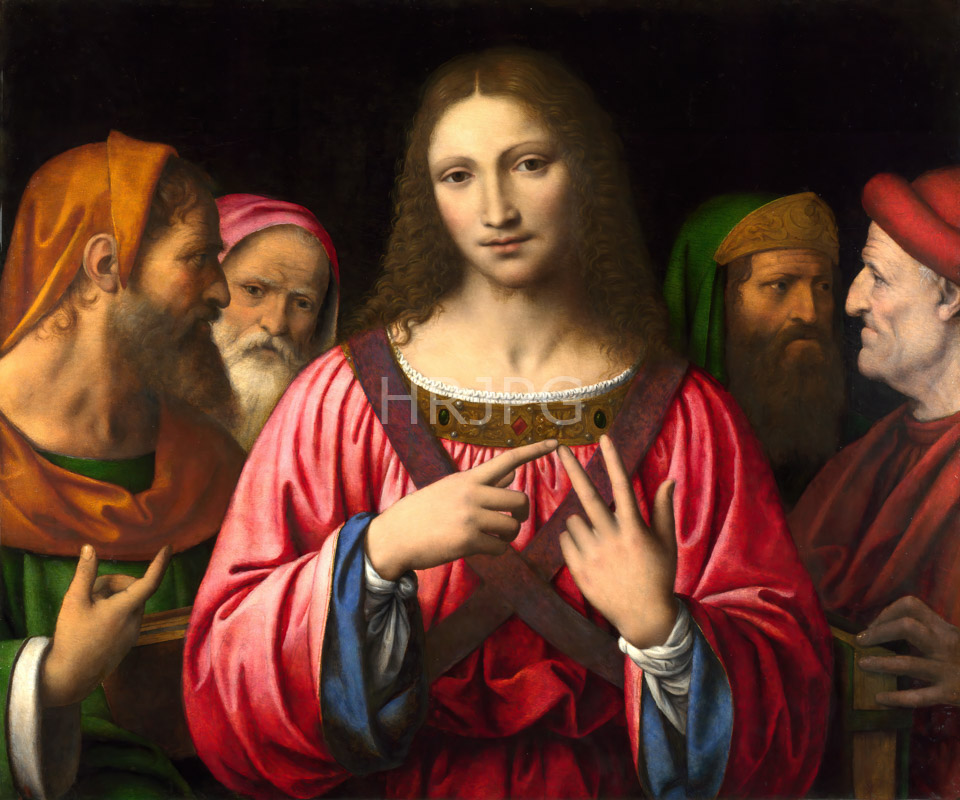
Bernardino Luini’s "Christ Among the Doctors" is a masterpiece of narrative clarity and psychological contrast, widely believed to be based on lost preparatory drawings by Leonardo da Vinci. The scene illustrates the biblical account of the young Jesus debating Jewish scholars in the Temple of Jerusalem. At the center of the composition stands the youthful Christ, his face an idealized vision of "Leonardesque" beauty—fair skin, soft golden curls, and an expression of serene, divine wisdom. His hands are positioned in a delicate, rhetorical gesture, symbolizing the clarity of his argument amidst the complex theological disputes of the elders.
The composition is defined by the sharp contrast between the radiant, smooth features of Jesus and the varied, often grotesque faces of the doctors surrounding him. These elderly scholars are depicted with a high degree of characterization, featuring wrinkled brows, hooked noses, and intense, skeptical gazes. This use of "physiognomy" reflects Leonardo’s deep interest in the connection between external appearance and internal character. Luini masterfully arranges these figures in a tight, frieze-like grouping, creating a sense of intellectual tension and physical density. The variety of textures—from the luxurious fur-lined robes and silken turbans of the doctors to the simple, luminous tunic of Christ—demonstrates Luini's technical skill and his eye for decorative detail.
The lighting in the painting is soft and diffused, creating a harmonious atmosphere that unifies the diverse cast of characters. While the doctors represent the weight of human tradition and intellectual labor, the young Christ represents the effortless light of divine revelation. Luini’s use of "sfumato" is particularly effective in the transitions around the eyes and mouths of the figures, imbuing the scene with a sense of living breath. This work was immensely popular in the early 16th century, as it managed to translate the master’s complex intellectual theories into a visual language that was accessible and emotionally resonant for a wider audience.
Today, "Christ Among the Doctors" is celebrated as one of the finest examples of the "Milanese School" under the influence of Leonardo. It serves as a vital record of the master's lost creative concepts while standing as a testament to Luini’s own genius for storytelling and his ability to capture the "sweetness" and grace of the High Renaissance. The painting remains a cornerstone of the National Gallery’s collection in London, continuing to fascinate viewers with its balance of youthful innocence and aged wisdom, all set within a space of profound theological inquiry.