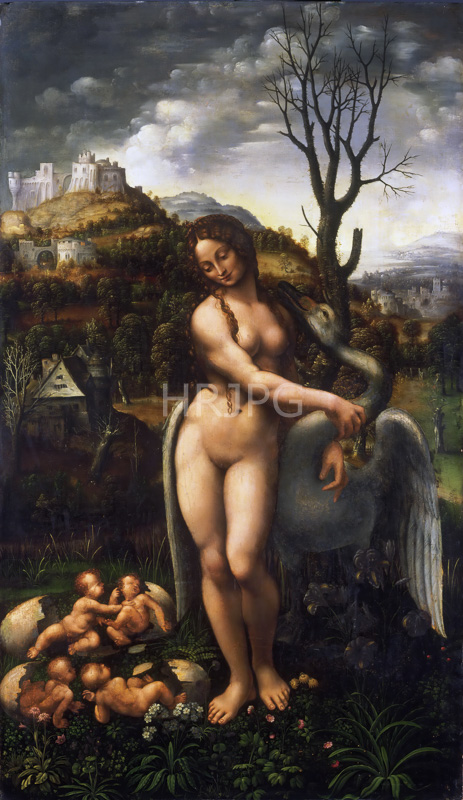
This version of "Leda and the Swan," often associated with the Spiridon collection, is one of the most complete and high-quality contemporary copies of Leonardo da Vinci’s lost mythological masterpiece. The original composition was the only large-scale mythological painting Leonardo ever executed, and its loss makes copies like this one invaluable to art history. The scene depicts the nude Leda standing in a graceful "contrapposto" pose, her body forming a subtle "serpentine" curve that was a hallmark of the High Renaissance. She tenderly embraces a large white swan, who is actually the god Zeus in disguise, while her four children—Castor, Pollux, Helen, and Clytemnestra—emerge from two large eggs at her feet.
The landscape in this version is remarkably detailed and reflects the scientific curiosity of the Vinci circle. It features a lush array of botanical species, from delicate flowers and grasses to dense ferns and trees, all rendered with a precision that echoes Leonardo’s own nature studies. In the distance, a misty, atmospheric landscape of hills and water recedes toward a pale horizon, utilizing the principles of aerial perspective to create a sense of deep, habitable space. The modeling of Leda’s body is achieved through soft "chiaroscuro," giving her flesh a supple, lifelike quality that contrasts with the rhythmic, almost sculptural feathers of the swan. Her expression is one of enigmatic, modest grace, a typical "Leonardesque" smile that suggests a complex interior life.
Technically, the painting demonstrates the high standards maintained by Leonardo’s pupils. The smooth, enamel-like surface and the subtle transitions of light and shadow indicate a mastery of the oil medium. Many scholars attribute this specific version to Francesco Melzi, Leonardo’s most devoted assistant and heir, who would have had direct access to the master’s original cartoons and techniques. The inclusion of the hatching infants adds a layer of fertility and cosmic mystery to the myth, emphasizing the generative powers of nature and the divine. This work is not merely a copy but a sophisticated recreation of a lost ideal, capturing the moment when the classical world was reborn through the lens of Renaissance science and humanism.
The "Leda" motif was highly influential, impacting artists from Raphael to Michelangelo. It represents a peak moment in the study of the female nude, moving away from static poses toward a dynamic, flowing grace. As a centerpiece of the Uffizi Gallery, this panel continues to provide scholars and the public with a glimpse into one of the most ambitious and influential compositions of the 16th century, standing as a monument to the enduring legacy of Leonardo’s artistic vision.