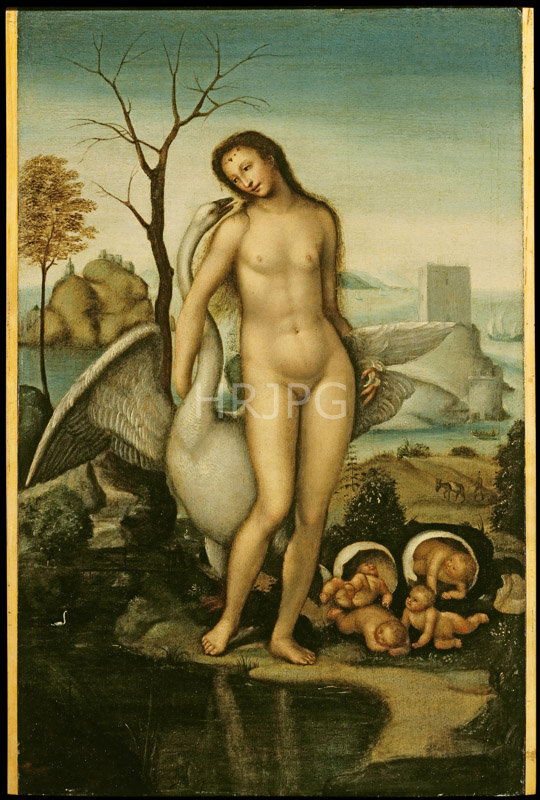
This striking interpretation of "Leda and the Swan," currently held in the Galleria Borghese in Rome, is traditionally attributed to Il Sodoma, an artist who famously synthesized the influences of the Sienese school with the revolutionary innovations of Leonardo da Vinci. While clearly derived from Leonardo’s original standing Leda composition, Sodoma imbues the scene with a unique sensuality and a more vibrant, almost eccentric decorative flair. The nude Leda stands in an elegant, twisted pose, her form modeled with a soft, glowing light that emphasizes the smoothness of her skin and the rhythmic curves of her silhouette. Unlike the more restrained versions by other Leonardo followers, Sodoma’s Leda possesses a dreamlike, almost ecstatic quality that is characteristic of his personal style.
The interaction between Leda and the swan is handled with a blend of mythological gravity and erotic undertone. The swan, representing Zeus, is depicted with a powerful, muscular grace, its long neck curving around Leda in a gesture of divine possession. At their feet, the infants hatching from eggs are rendered with a charming, playful naturalism, their small bodies mirroring the complex poses of the adult figures. The background landscape is a marvel of atmospheric depth, featuring a winding river, distant blue mountains, and a pale, luminous sky. Sodoma uses a more colorful and varied palette than the typical Milanese "Leonardeschi," reflecting the influence of Central Italian painting and his own penchant for theatricality.
Technically, the painting showcases Sodoma’s fluid brushwork and his mastery of light and shadow. The way he handles the textures—from the soft down of the swan’s feathers to the lush, damp foliage of the riverbank—shows a keen observation of nature filtered through a highly stylized aesthetic. This work reflects the "Leonardism" that swept through Italy in the early 16th century, showing how the master’s designs were adapted and transformed by artists of different temperaments. Sodoma’s Leda is less of a scientific study and more of a poetic, mythological vision, prioritizing mood and visual pleasure over intellectual rigor.
The painting remains one of the most famous versions of the subject, serving as a vital link between the High Renaissance and the emerging Mannerist style. It captures the era's fascination with the classical past and the exploration of themes of transformation and desire. Within the context of the Borghese collection, the work stands as a testament to Sodoma’s role as a bridge between different regional styles, and his ability to create images of haunting beauty and enduring mythological power.