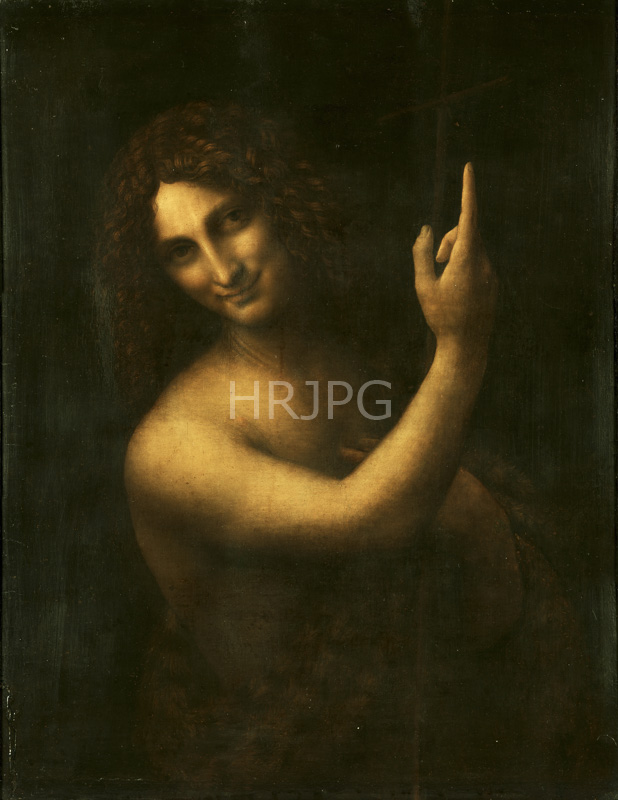
Leonardo da Vinci’s "Saint John the Baptist" is one of the most enigmatic and psychologically complex works in the history of art, representing the culmination of the master's lifelong obsession with light, shadow, and the mysteries of the human soul. Painted during his final years in Rome and France, the work depicts the saint as a youthful, androgynous figure emerging from a dense, impenetrable darkness. This is the ultimate expression of Leonardo’s "sfumato" technique; the outlines of the figure are almost entirely dissolved, with the forms modeled through incredibly subtle gradations of light that seem to breathe and pulsate within the shadows. Saint John’s pose is iconic: his right hand points upward toward heaven, while his left hand holds a slender wooden cross, his enigmatic, knowing smile inviting the viewer into a space of spiritual ambiguity.
The androgyny of the figure has been a subject of intense scholarly debate for centuries. Leonardo moves away from the traditional, rugged depiction of the desert-dwelling ascetic, presenting instead a figure of ethereal, idealized beauty. The long, curling hair and the soft, supple flesh are rendered with a tactile realism that is both seductive and divine. This ambiguity reflects Leonardo’s philosophical belief in the unity of opposites and the mysterious nature of the divine. The dark background, known as "tenebrism," serves to eliminate all external distractions, forcing the viewer to confront the figure’s intense, focused gaze. The light appears to emerge from within the saint himself, symbolizing the internal light of faith and prophecy.
Technically, the painting is a masterpiece of oil glazing. Leonardo applied dozens of ultra-thin layers of pigment to achieve the translucent quality of the skin and the deep, atmospheric shadows. The anatomical precision—visible in the tension of the pointing finger and the structure of the torso—demonstrates that even in his late style, Leonardo’s art was firmly grounded in his scientific observations. The painting is famously "dark," a result of both the artist's original intent and the natural darkening of the oil glazes over time. This darkness creates a sense of "sacred mystery," suggesting that the ultimate truths of the spirit are hidden from the casual eye.
As the final major painting completed by Leonardo, "Saint John the Baptist" serves as his artistic testament. It challenged the conventions of religious art and paved the way for the dramatic contrasts of the Baroque period. The work's influence can be seen in the paintings of Caravaggio and Rembrandt, who further explored the expressive potential of light emerging from darkness. Now a treasure of the Louvre Museum, it remains a haunting and beautiful reminder of Leonardo’s genius for combining scientific rigor with the deepest, most unfathomable questions of human existence and the divine.