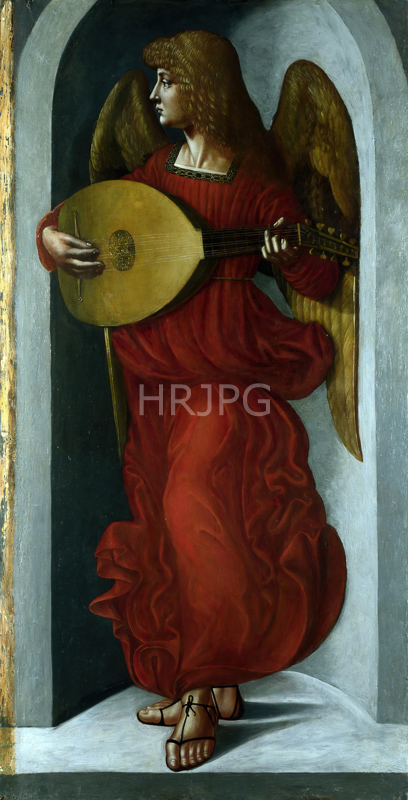
This panel, "An Angel in Red with a Lute," is a cornerstone of Milanese Renaissance art, originally forming part of the monumental altarpiece for the Church of San Francesco Grande in Milan. This ambitious project is most famous for its central panel—Leonardo da Vinci’s "Virgin of the Rocks." While Leonardo focused on the central divine mystery, his close associate and collaborator, Giovanni Ambrogio de Predis, was tasked with creating the flanking panels of musician angels. This specific figure, an angel dressed in vibrant, heavy crimson robes, is depicted playing a lute with a look of serene, celestial concentration. The figure stands within a gray stone niche, a compositional device that provides a strong sense of three-dimensional space and anchors the angel within the larger architectural framework of the now-dispersed altarpiece.
Giovanni Ambrogio de Predis was the preeminent portraitist and court painter for the Sforza family, and his style represents a distinct blend of Milanese linear precision and the atmospheric innovations introduced by Leonardo. In this work, the influence of Leonardo is visible in the idealized facial features—the straight nose, heavy-lidded eyes, and the soft, curling hair that seems to catch the light. However, de Predis maintains a focus on the tactile reality of materials that is uniquely his own. The deep folds of the red fabric are modeled with strong chiaroscuro, giving the garment a sculptural weight and a rich, silken sheen. The intricate details of the lute, from the wood grain to the tension of the strings, demonstrate the artist’s commitment to technical accuracy and the High Renaissance interest in "Musica Sacra" (Sacred Music) as a reflection of cosmic harmony.
The role of these musician angels was not merely decorative; they served a liturgical function, symbolizing the heavenly choir that eternally praises the Virgin and Child. By flanking Leonardo’s central masterpiece, these panels by de Predis provided a bridge between the ethereal, mysterious world of the "Virgin of the Rocks" and the more structured, material world of the church interior. The lighting in this panel is more direct than Leonardo’s diffused glow, creating sharp highlights on the angel’s forehead and hands, which emphasizes the physical act of music-making. Over the centuries, this work has come to be recognized as one of the finest examples of the collaborative workshop system that defined the Italian Renaissance.
Today, as part of the National Gallery’s collection in London, "An Angel in Red with a Lute" remains an essential piece of the puzzle for understanding the artistic environment of Milan under Ludovico il Moro. It showcases how Leonardo’s revolutionary "sfumato" was adapted and interpreted by talented local masters to suit the tastes of the court and the requirements of religious devotion. The painting stands as a testament to de Predis’s skill in imbuing a static, devotional image with a sense of living grace and profound spiritual dignity.