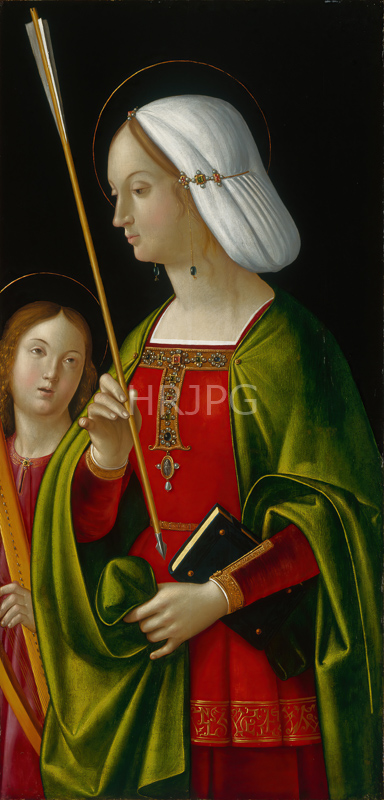
Andrea Solario's "Saint Ursula" is a masterpiece of early 16th-century religious portraiture, showcasing the artist’s unique ability to combine the soft modeling of the Milanese school with the crisp, detailed realism of Northern European traditions. Solario, who spent time in France and was exposed to Flemish and German art, brought a distinct sense of tactile clarity to the Leonardesque style. In this painting, Saint Ursula—a legendary princess-martyr—is shown in a three-quarter turn, holding the arrow of her martyrdom and a prayer book. Her attire is that of a contemporary High Renaissance noblewoman, featuring a rich green gown with vibrant red sleeves and an intricate, jeweled headdress. The presence of a smaller female figure in the background, likely one of her eleven thousand virgin companions, adds a narrative depth to the devotional image.
The physical presence of the saint is modeled with an extraordinary sense of volume. Solario uses a focused, clear light that emphasizes the smoothness of the skin and the complex textures of the luxurious fabrics. The influence of Leonardo da Vinci is evident in the idealized, serene expression of the saint and the subtle "sfumato" around the eyes and mouth. However, Solario’s preference for a more brilliant, saturated color palette distinguishes him from the more monochromatic tendencies of other "Leonardeschi." The deep greens and reds are balanced by the cool, pale flesh tones, creating a visual harmony that is both striking and contemplative. The arrow she holds is rendered with a metallic sheen that reflects Solario’s mastery of still-life details.
Ursula’s expression is one of calm resignation and divine focus, embodying the virtues of faith and courage in the face of martyrdom. The prayer book serves as a symbol of her intellectual and spiritual devotion. Technically, the work is characterized by a high degree of finish; the individual jewels on her dress and the fine embroidery are rendered with a precision that rivals the works of Hans Holbein or Quentin Matsys. This attention to detail does not detract from the overall monumental feel of the figure, which is anchored firmly within the composition. Solario’s "Saint Ursula" represents a peak in the internationalization of the Vinci style, showing how it could be adapted to include the meticulous observation of the material world.
As part of the National Gallery’s collection in London, this panel remains a vital example of Solario’s mature period. It illustrates the high cultural sophistication of the patrons who commissioned such works for private altars or chapels. The painting stands as a testament to Solario’s status as a leading figure in the Lombard Renaissance, an artist who could bridge the gap between different European aesthetic traditions to create a unique, enduring vision of sacred beauty and human dignity.