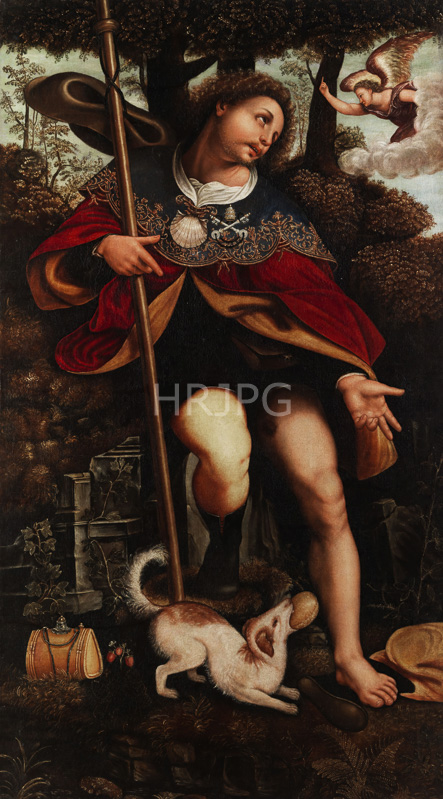
Cesare da Sesto was one of the most intellectually curious and stylistically versatile of Leonardo da Vinci’s followers, and his "Saint Roch" (San Rocco) is a profound example of his mature style, which synthesized the soft "sfumato" of Milan with the monumental forms of Roman High Renaissance art. Saint Roch, the patron saint against the plague, is depicted standing in a lush, wooded landscape. He is shown in his traditional pilgrim’s attire, lifting his tunic to reveal the plague sore on his thigh—a gesture of both suffering and divine protection. Beside him is his faithful dog, who according to legend brought him bread while he was in exile, and an angel appearing in the clouds above, symbolizing divine intervention and healing.
The figure of Saint Roch is characterized by a muscular grace that reflects Cesare’s study of Michelangelo and Raphael during his time in Rome. The pose is dynamic and slightly "serpentine," moving away from the static compositions of the earlier 15th century. However, the facial features and the treatment of the hair remain firmly rooted in the Leonardesque tradition, with soft transitions of light and shadow and a thoughtful, interior expression. The landscape is a marvel of Renaissance botanical and atmospheric observation; the dense trees and the rocky path in the foreground are rendered with a dark, evocative "chiaroscuro," while the distant mountains fade into a misty, pale blue horizon using aerial perspective.
Technically, the painting showcases Cesare’s fluid brushwork and his sophisticated use of color. The deep blues of the saint’s cloak and the warm, earthy tones of the landscape are unified by a soft, golden light that filters through the canopy. The interaction between the human figure and the natural world is central to the work’s meaning, suggesting that the divine can be found within the wild and untamed aspects of nature. The angel in the sky is rendered with a translucent, ethereal quality that contrasts with the solid, physical presence of the saint below. This balance between the spiritual and the material was a hallmark of Cesare’s best works.
In the context of the 1520s, a period marked by frequent plague outbreaks in Italy, this image of Saint Roch would have been a powerful object of devotion and hope. It demonstrates how Cesare da Sesto took the foundational lessons of Leonardo and expanded them into a more dramatic and emotionally expressive visual language. Today, "Saint Roch" is regarded as one of Cesare’s finest religious works, standing as a testament to his role as a bridge between different regional styles and his ability to imbue traditional iconography with a new sense of High Renaissance monumentality and psychological depth.