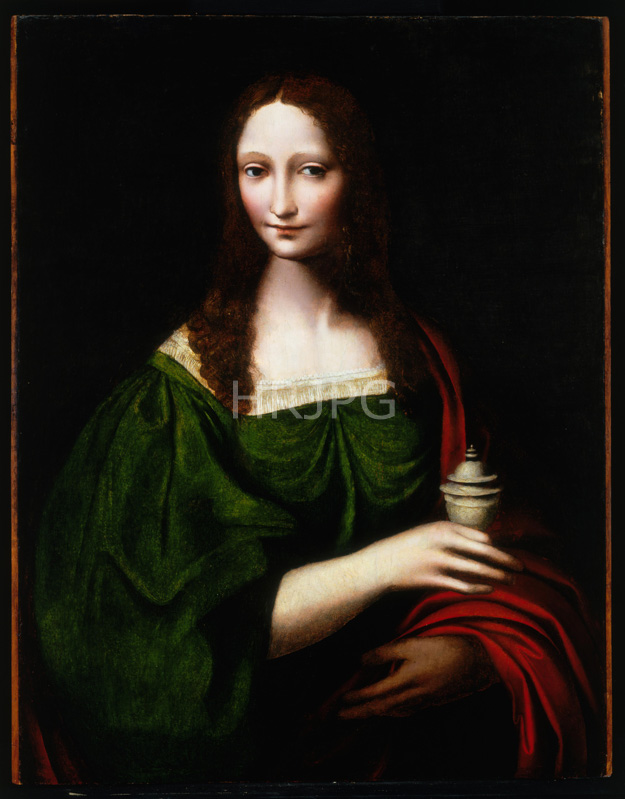
Giampietrino, one of the most prolific and technically adept members of Leonardo da Vinci’s Milanese circle, is perhaps best known for his numerous and highly idealized depictions of "Saint Mary Magdalene." This specific version, likely painted around 1521, captures the saint in a half-length portrait that perfectly embodies the "Leonardesque" aesthetic of the early 16th century. The Magdalene is shown with her characteristic long, flowing hair—often a symbol of her former life as a sinner—and she holds an ornate ointment jar, her primary attribute. Her gaze is turned slightly away from the viewer with a subtle, enigmatic smile that echoes the world-famous "Mona Lisa." The composition is characterized by a profound sense of stillness and a cool, crystalline beauty that was Giampietrino’s signature.
The use of "sfumato" is masterfully applied to the modeling of the saint’s face and torso. Giampietrino dissolves the outlines into a soft, hazy shadow, giving the skin a porcelain-like, luminous quality. This technique creates a sense of living flesh while maintaining an idealized, almost divine perfection. The Magdalene is dressed in a rich green gown, its deep folds modeled with strong "chiaroscuro" against a stark, dark background. This dramatic lighting pushes the figure forward, emphasizing her physical volume and the tactile quality of her hair and the metallic jar. The influence of Leonardo’s anatomical studies is visible in the delicate rendering of the hands and the subtle tension in the neck and shoulders.
During the Renaissance, images of the repentant Magdalene were highly popular for private devotion, representing the possibility of redemption and the power of divine love. Giampietrino’s interpretation focuses on the saint’s spiritual beauty rather than her suffering, presenting her as an icon of grace and contemplation. The technical finish of the work is exceptionally high, with smooth, enamel-like surfaces that have preserved the vibrancy of the pigments over the centuries. While Giampietrino was once seen as a mere imitator of Leonardo, modern scholars recognize his role in standardizing and disseminating the "Vinci style" to a wide audience across Lombardy and beyond.
Today, this "Saint Mary Magdalene" (versions of which are found in the Portland Art Museum and other major collections) stands as a testament to the enduring appeal of the Leonardesque ideal. It showcases the high level of skill maintained in the master’s workshop and reflects the intellectual and aesthetic climate of Milan in the decades following Leonardo’s departure. The work remains a hauntingly beautiful example of High Renaissance sacred art, where the boundaries between the human and the divine are blurred through a visual language of peak elegance and technical refinement.