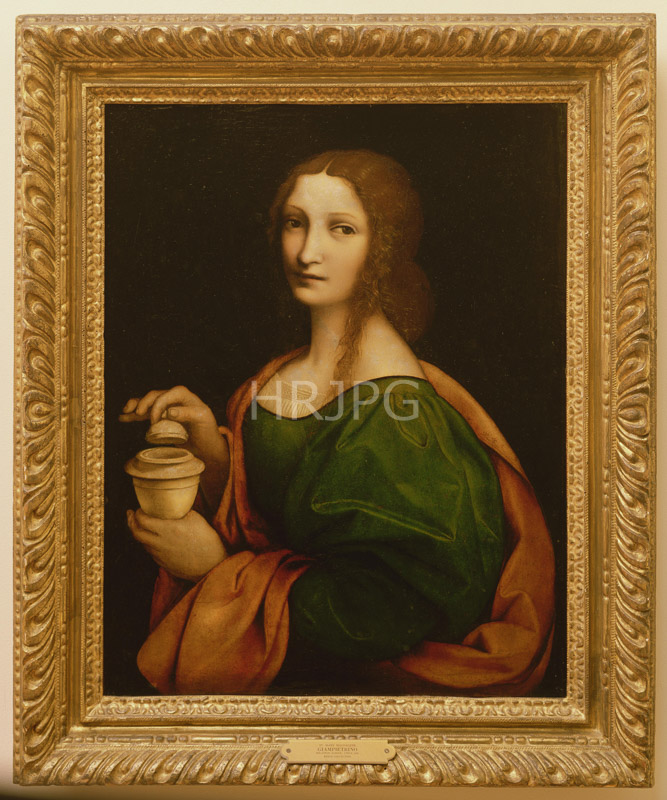
Giampietrino's 1521 depiction of "Saint Mary Magdalene" is a superlative example of the Milanese school's obsession with the "Leonardesque" ideal. Giampietrino, one of Leonardo da Vinci’s most devoted and prolific pupils, specialized in creating images that blended sacred narratives with an almost sensuous beauty. In this specific version, Mary Magdalene is shown in a half-length portrait, her body turned slightly as she gazes toward her primary attribute: an ornate, metallic ointment jar. Her long, reddish-brown hair, traditionally a symbol of her past life and her subsequent repentance, flows over her shoulders in soft, meticulously rendered waves. Her expression is the epitome of the "Vinci smile"—a subtle, knowing, and enigmatic look that suggests a complex inner state of grace and contemplation.
The technical execution of the skin is a masterclass in "sfumato." Giampietrino employs ultra-thin layers of oil glazes to create a seamless transition between light and shadow, giving the skin a luminous, porcelain-like quality. The outlines of the figure are softly blurred, making her appear to emerge naturally from the deep, dark background. She wears a rich emerald-green gown, its fabric modeled with strong "chiaroscuro" to emphasize its weight and the sculptural volume of her form. The contrast between the cool tones of her dress and the warm, pale glow of her flesh creates a visual harmony that is both striking and serene. The influence of Leonardo’s anatomical studies is evident in the delicate structure of her hands and the elegant curve of her neck.
During the Counter-Reformation and the years leading up to it, the figure of the repentant Magdalene was a powerful symbol of the Catholic Church’s message of redemption. Giampietrino’s version, however, prioritizes an idealized, classical beauty that reflects the High Renaissance spirit. The work was likely intended for the private chapel or study of a sophisticated Milanese patron who valued both the theological significance and the aesthetic perfection of the Vinci style. Giampietrino’s ability to standardize this specific type of beauty made him one of the most successful artists of his generation, ensuring that Leonardo’s visual innovations reached a wide audience across Italy and Europe.
Today, this painting (versions of which are found in major institutions such as the Poldi Pezzoli Museum) remains a vital document of the artistic legacy of Leonardo in Milan. It showcases the high level of craftsmanship maintained in the master's circle and continues to fascinate viewers with its combination of physical allure and spiritual mystery. It stands as a testament to Giampietrino's role as a primary guardian of the "Vinci brand," translating the master's radical theories into a visual language of peak elegance and enduring popular appeal.