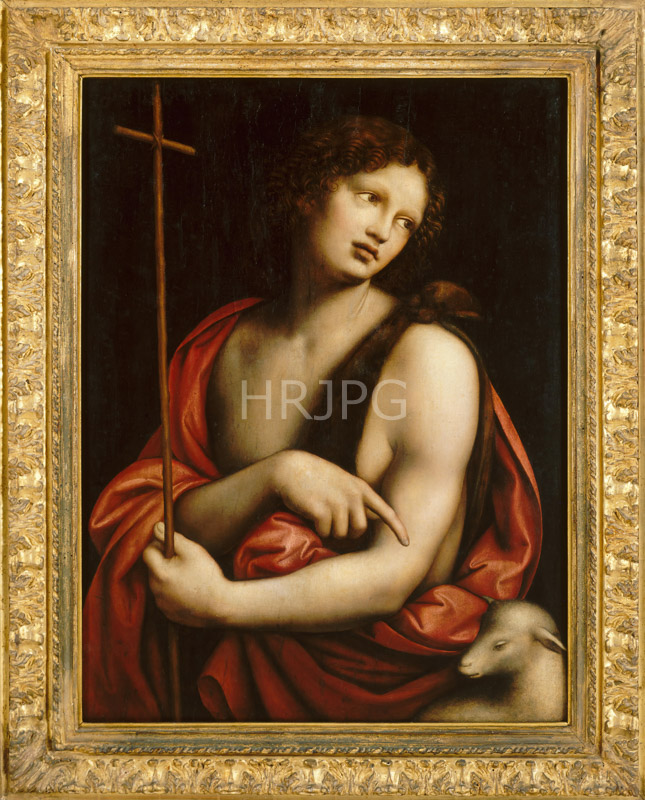
Giampietrino’s "Saint John the Baptist" is a hauntingly beautiful and psychologically complex work that directly references Leonardo da Vinci’s late masterpiece on the same subject. In this version, Giampietrino depicts the saint as a youthful, almost androgynous figure emerging from a dense, impenetrable darkness. The saint holds a slender wooden cross in one hand and points his right index finger upward—a characteristic "Leonardesque" gesture indicating the divine source of his prophecy. Beside him, a small, docile lamb rests, symbolizing Christ as the "Lamb of God" whose arrival John came to announce. The figure is characterized by long, golden curling hair and a soft, idealized face that radiates an ethereal light, contrasting sharply with the deep "tenebrism" of the background.
The modeling of the figure is achieved through a sophisticated use of "sfumato," where the transitions between light and shadow are so subtle that they appear to breathe. This technique gives the saint a tangible physical presence while imbuing him with a sense of divine mystery. Giampietrino’s Saint John is less the rugged ascetic of traditional desert iconography and more a celestial herald of the High Renaissance. The influence of Leonardo is paramount, yet Giampietrino adds his own sense of "sweetness" and decorative finish, particularly in the rhythmic arrangement of the curls and the luminous quality of the skin tones. The light appears to emanate from the figure itself, a visual metaphor for the light of revelation breaking through the darkness of the world.
Technically, the painting showcases Giampietrino’s mastery of the oil medium and his deep understanding of anatomical structure. The tension in the pointing hand and the soft modeling of the torso demonstrate the scientific rigor that underpinned the art of the Vinci workshop. This work reflects the spiritual atmosphere of early 16th-century Milan, where religious devotion was often expressed through images of idealized beauty and psychological stillness. The androgynous nature of the saint served to blur the boundaries between the human and the divine, inviting a more contemplative and mystical engagement from the viewer.
Historically, this "Saint John the Baptist" served as a powerful object for private devotion and was part of the wider dissemination of Leonardo's late style. Giampietrino’s ability to capture the haunting, enigmatic qualities of his master's work made him a favored artist among the elite. Today, the painting remains an important example of the "Milanese School," standing as a bridge between the radical innovations of Leonardo and the more emotionally direct religious art of the later 16th century. It continues to intrigue scholars and art lovers alike for its combination of technical perfection and profound spiritual ambiguity.