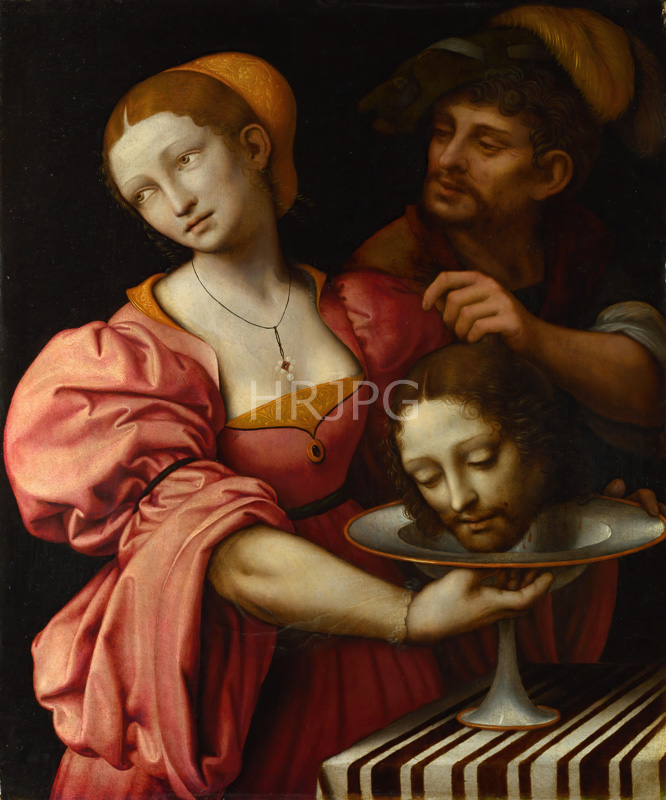
Giampietrino’s "Salome" is a chillingly beautiful and technically refined exploration of one of the most dramatic and gruesome stories in the New Testament. The painting depicts Salome, the daughter of Herodias, at the moment she receives the severed head of Saint John the Baptist on a silver platter. Giampietrino, following the lead of his master Leonardo da Vinci, chooses to emphasize the "Leonardesque" grace and physical allure of the protagonist, creating a disturbing contrast between her idealized beauty and the horrific object she holds. Salome is shown in a three-quarter turn, dressed in a vibrant, jewel-toned pink gown with intricate gold detailing and a translucent white chemise, her long hair neatly bound in the Milanese fashion of the era.
The figure of Salome is modeled with an exceptional use of "sfumato," giving her skin a luminous, porcelain-like quality. Her expression is one of detached, almost tranquil focus, with a subtle smile that echoes the enigmatic countenances found in Leonardo’s own work. The severed head of the Baptist, by contrast, is rendered with a somber, realistic "chiaroscuro," his features frozen in death. This juxtaposition is a hallmark of Giampietrino’s style, where the grotesque and the beautiful are merged into a single, balanced composition. The dark, monochromatic background serves to project the figures forward, making the physical volume of Salome’s form and the gleam of the silver platter the central focus of the viewer’s gaze.
Technically, the painting showcases Giampietrino’s mastery of the oil medium and his eye for decorative detail. The way the light reflects off the silver platter and the individual pearls on Salome's dress demonstrates the high technical standards of the Milanese school. The anatomical modeling of Salome’s hands and the subtle tension in her pose reflect the scientific rigor of Leonardo’s workshop. During the Renaissance, the story of Salome was a popular subject for its combination of moral caution, mythological drama, and the opportunity to depict the idealized female nude or semi-nude. Giampietrino’s version remains one of the most successful interpretations of the theme, prioritizing an overall sense of rhythmic harmony and aesthetic perfection.
As a key work of the "Leonardeschi," this "Salome" (versions of which are held in the National Gallery in London and the Kunsthistorisches Museum in Vienna) illustrates how Leonardo's intellectual innovations were adapted for a wider, aristocratic market. Giampietrino was not merely an imitator but an artist who perfected a specific type of polished, high-contrast beauty that became synonymous with the Milanese Renaissance. The painting continues to fascinate and unsettling viewers, standing as a testament to the enduring power of the Vinci style and its ability to imbue even the most violent subjects with a sense of eternal, crystalline grace.