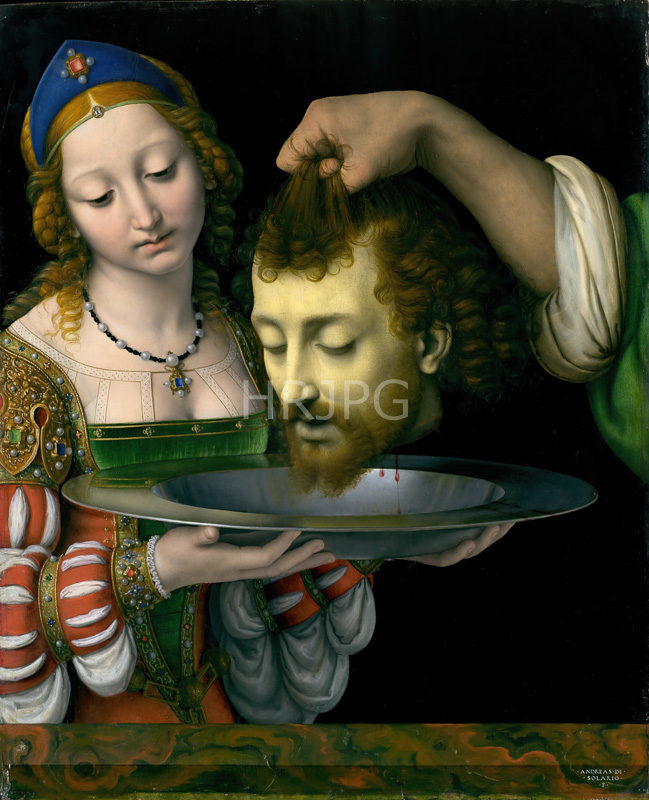
Andrea Solario’s "Salome with the Head of Saint John the Baptist" is a pinnacle of the Lombard Renaissance, showcasing the artist’s unique ability to blend the soft, atmospheric mystery of Leonardo da Vinci with the unflinching, tactile realism of the Northern European tradition. Painted during Solario’s full maturity, this work presents a dramatic and unsettling encounter between the beautiful Salome and the gruesome evidence of the Baptist’s execution. The composition is tightly focused, pushing the figures into the viewer's immediate psychological space. Salome is depicted with a porcelain-like complexion and an idealized grace, her serene expression contrasting sharply with the severed head held by the executioner. This juxtaposition of the beautiful and the grotesque is a hallmark of the Vinci circle’s exploration of human emotion and contrast.
The figure of Salome is rendered with exceptional technical refinement. Her attire, featuring a rich green gown and translucent white chemise, is modeled with a focused light that emphasizes the varied textures of the silk and linen. Solario’s use of "sfumato" is masterfully applied to her face and hands, creating soft, rhythmic transitions that imbue her with a sense of living breath. Her gaze is turned away from the platter, suggesting a complex mixture of cold detachment and tragic realization. The executioner’s hand, plunging the severed head onto the silver platter, is rendered with a dark, muscular "chiaroscuro" that provides a powerful rhythmic counterpoint to Salome's delicate form. This interaction creates a "serpentine" movement that leads the eye across the narrative climax of the biblical story.
Technically, the painting is a tour de force of oil glazing. Solario achieved a luminous, enamel-like surface that captures the glint of the silver platter, the individual strands of the Baptist’s damp hair, and the glistening droplets of blood with startling clarity. The dark, impenetrable background serves to project the scene forward, heightening the emotional impact of the martyrdom. Solario’s version of this popular Renaissance theme was highly influential, reflecting the era's fascination with the psychological weight of the Passion narratives and the exploration of the "ideal woman" in extreme circumstances. Now a treasure of the Metropolitan Museum of Art and other major collections, this work stands as a testament to Solario’s status as a master who could harmonize intellectual rigor with a raw, visceral emotionalism that resonated across the courts of Europe.