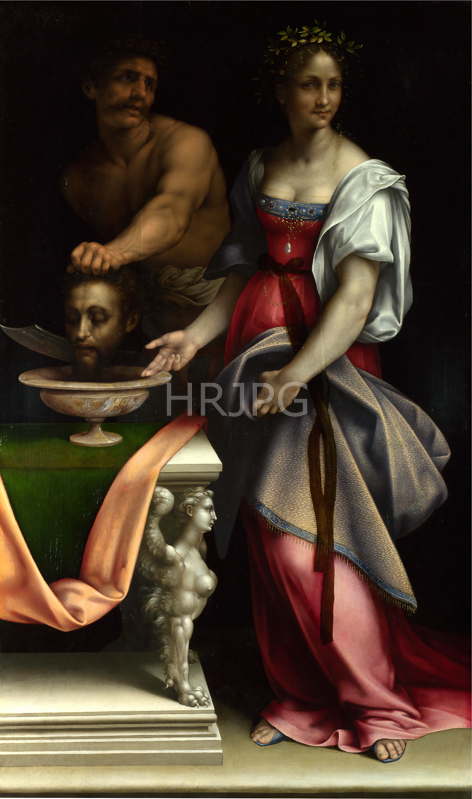
Cesare da Sesto’s "Salome with the Head of Saint John the Baptist" is a striking example of the artistic cross-pollination that defined the High Renaissance in Italy. Cesare, who moved between the workshops of Leonardo in Milan and the influence of Raphael and Michelangelo in Rome, developed a style that combined Leonardesque mystery with a new sense of dynamic, monumental form. In this composition, Salome is presented as a figure of haunting beauty and complex intent. Her pose is elegantly contorted, displaying the "serpentine" movement that was becoming a hallmark of the late Renaissance. She holds the platter with a sense of ritualistic gravity, her face modeled with the soft, diffused light and enigmatic expression that directly echo the master’s "Mona Lisa."
The interaction between the characters is defined by a tense, psychological drama. The executioner, often depicted as a dark and muscular foil to Salome’s pale refinement, adds a sense of raw physical power to the scene. Cesare uses a dramatic "chiaroscuro" to anchor the figures against a dark, evocative background, often featuring classical architectural elements that hint at his Roman experiences. The textures of the materials—from the heavy, embroidered fabrics of Salome’s dress to the cold metallic sheen of the platter—are rendered with a technical precision that reflects the high standards of the Milanese school. The lighting appears to emerge from within the figures, highlighting the subtle transitions of the skin and the individual curls of the hair, giving the composition a luminous, sacred quality.
During the early 16th century, the story of Salome was frequently used by artists to explore the boundaries of beauty, cruelty, and divine justice. Cesare’s interpretation focuses on the intellectual and aesthetic qualities of the myth, prioritizing a balanced and harmonious organization of forms. His "Salome" serves as a vital document of the "Leonardeschi" evolution, showing how the master's foundational lessons were expanded into a more theatrical and emotionally expressive visual language. The work reflects the cultural sophistication of the patrons who sought images that were both religiously significant and stylistically innovative. Technically, the smooth, polished surface of the oil-on-panel demonstrates Cesare’s mastery of the medium and his ability to imbue traditional iconography with a new, monumental dignity that looked forward to the developments of Mannerism.