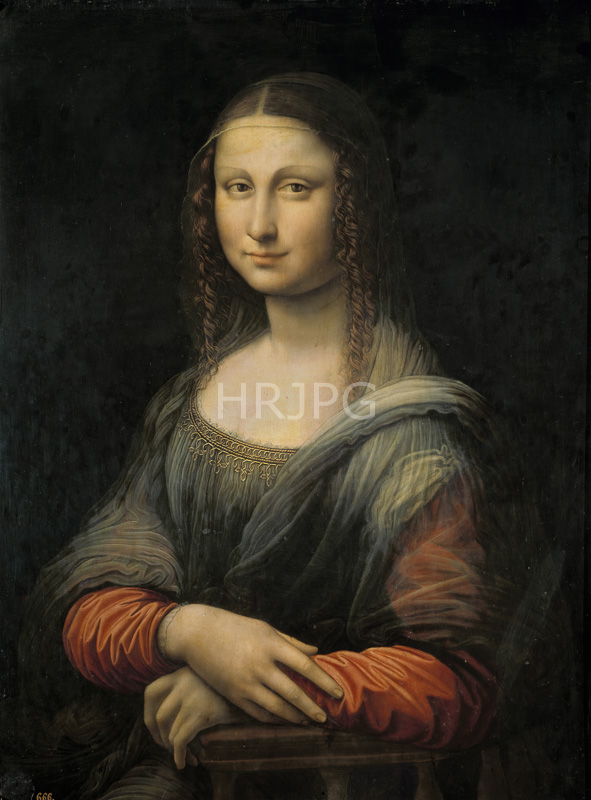
The "Prado Mona Lisa" is perhaps the most significant and revealing contemporary copy of Leonardo da Vinci’s world-famous masterpiece. Housed in the Museo del Prado in Madrid, this painting was long considered an unremarkable, later copy due to its dark, opaque background. However, a landmark restoration in 2012 revealed a stunning, high-quality landscape nearly identical to the original in the Louvre. Scholars now believe this work was executed simultaneously with the original by a talented pupil—likely Salaì or Francesco Melzi—working directly beside Leonardo in his studio. Because the Prado version was better preserved and not subjected to the heavy varnishes and environmental darkening that affected the Louvre original, it provides a crucial "time machine" for understanding how the "Mona Lisa" appeared in the early 16th century.
The painting displays an extraordinary level of technical skill. The "sfumato" in the face and hands is handled with a delicacy that mirrors Leonardo’s own technique, yet the colors are noticeably more vibrant and the outlines slightly more defined. The lady’s red sleeves and the rich embroidery of her dress are rendered with a clarity that has been lost in the Louvre version. Most importantly, the landscape—with its jagged mountains, winding paths, and atmospheric blue horizon—reveals details that are now obscured in the original. This version confirms that the "Mona Lisa" was originally intended to be seen as a brilliant, light-filled composition. The eyebrows and eyelashes, which are famously "missing" from the Louvre painting, are visible here, suggesting they may have simply faded or been removed during past cleanings of the master’s work.
The existence of the Prado Mona Lisa has revolutionized our understanding of Leonardo’s workshop practices. It proves that the master allowed his students to follow his creative process step-by-step, creating high-quality "studio versions" of his most important commissions. The interaction between the two works allows art historians to trace the evolution of the composition and the specific aesthetic choices Leonardo made. This version remains a masterpiece in its own right, standing as a testament to the high technical standards maintained in the Vinci circle. It offers a rare glimpse into the "living" art of the Renaissance, before centuries of time and restoration altered the most famous face in history. As a centerpiece of the Prado's collection, it continues to be a vital object of study for those seeking to unlock the secrets of Leonardo’s genius and the enduring mystery of the "Gioconda" smile.