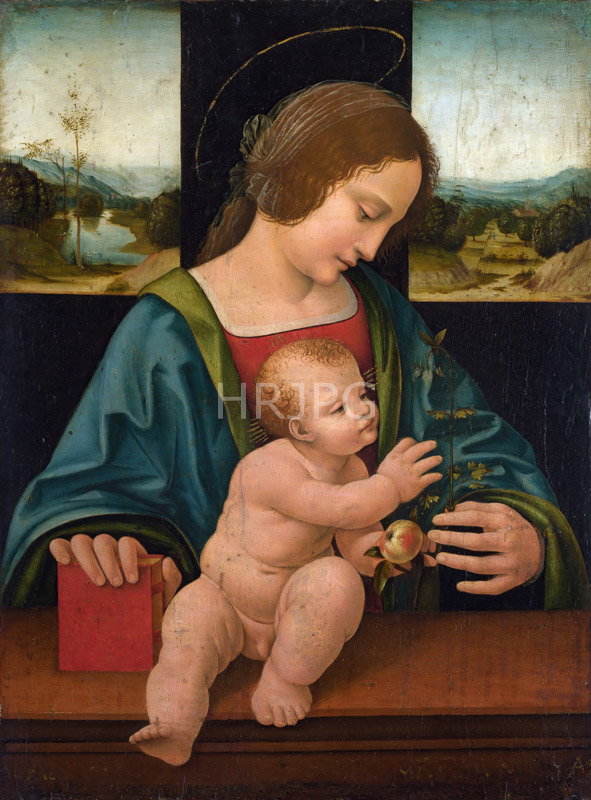
This "Virgin and Child," produced within the circle of Giovanni Antonio Boltraffio, is a beautiful example of the Milanese school’s synthesis of Leonardesque grace and courtly elegance. Boltraffio was arguably Leonardo da Vinci’s most talented and socially prominent pupil, and his influence shaped a generation of artists in Milan. This composition follows a popular "Leonardeschi" template: the Virgin Mary is shown in a three-quarter turn, cradling the infant Christ against a dark interior that opens through a window to a distant, atmospheric landscape. This device, known as "looking out," was a favorite of the Vinci workshop, serving to bridge the sacred, domestic space with the vastness of the natural world.
The Virgin is depicted with the idealized features and serene expression that defined the Boltraffio style—heavy-lidded eyes, a straight, noble nose, and a subtle smile. Her skin is modeled with a delicate "sfumato," giving it a luminous, porcelain-like quality. The infant Christ is rendered with a remarkable naturalism, his chubby, realistic anatomy reflecting the scientific studies of human growth that Leonardo pioneered. He often interacts with a symbolic object, such as a bird or a piece of fruit, which foreshadows his future role in the Passion. The lighting is soft and diffused, highlighting the luxurious textures of the Virgin’s attire—often featuring rich blues and golds that reflect the high fashion and material wealth of the Milanese court under the Sforza family.
Technically, the painting showcases the high standards of the Milanese "oil-on-panel" tradition. The transitions between light and shadow are seamless, creating a powerful sense of three-dimensional volume without the use of harsh outlines. The background landscape, with its pale, misty mountains and winding paths, utilizes aerial perspective to create a sense of deep, unbridgeable space. This work reflects the shifting needs of private devotion in the early 16th century, where patrons desired images that were both religiously profound and aesthetically "modern." By adapting Leonardo’s radical innovations into a more polished and decorative format, Boltraffio’s followers ensured the master’s legacy remained the dominant visual force in Northern Italy for decades. This "Virgin and Child" remains a testament to that legacy, capturing a moment of divine peace with a unique blend of physical realism and aristocratic refinement.