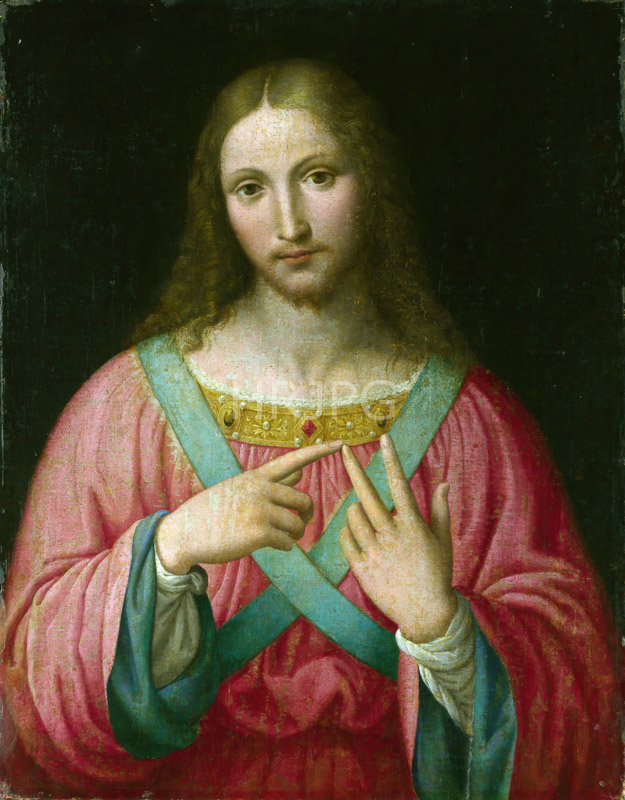
Bernardino Luini’s "Salvator Mundi" (Savior of the World) is a masterclass in the "sweet" style that made him the most beloved and successful of Leonardo da Vinci’s Milanese followers. This devotional image depicts Christ as the sovereign of the world, presenting a vision of divine authority tempered by profound human compassion. Christ is shown half-length, his right hand raised in a gesture of benediction, while his left hand is placed over his heart, a variation on the more common motif where he holds a crystal orb. The influence of Leonardo is immediately apparent in the symmetrical composition and the soft, atmospheric "sfumato" that models the features, yet Luini infuses the work with a distinctive clarity and narrative warmth that was his own hallmark.
The face of Christ is an idealized vision of High Renaissance beauty. Luini uses ultra-thin layers of oil glazes to create the luminous skin tones and the soft, flowing curls of the hair, which seem to catch a divine light. The expression is one of serene, knowing wisdom, with the "Leonardesque" smile suggesting a state of eternal grace. Christ wears a rich pink robe adorned with intricate blue ribbons and jeweled collars, details that reflect Luini’s penchant for decorative elegance and the high technical standards of his workshop. The use of "chiaroscuro" provides a powerful sense of volume, making the figure appear to emerge from the dark, monochromatic background into the viewer’s immediate space of prayer.
Technically, the painting is characterized by a high degree of finish and a harmonious color palette. Luini’s mastery of the oil medium allowed him to achieve a level of tactile realism in the fabrics and the jewels that appealed greatly to the Milanese elite. During the early 16th century, images of the "Salvator Mundi" were popular for private meditation, and Luini’s versions were considered the gold standard for their combination of spiritual dignity and aesthetic perfection. While Leonardo’s own "Salvator Mundi" was more mysterious and scientifically complex, Luini’s interpretation was more accessible and emotionally resonant, bridging the gap between the master’s radical intellectualism and the traditional needs of Catholic devotion.
Today, this work (a version of which is held in the Poldi Pezzoli Museum) remains a vital example of the "Milanese School" legacy. It demonstrates how the principles of the High Renaissance were adapted and standardized to create a lasting visual language of faith. Luini’s "Salvator Mundi" stands as a monument to his genius for storytelling and his ability to imbue even a static, iconic subject with a sense of living, breathing divinity and enduring human relevance.