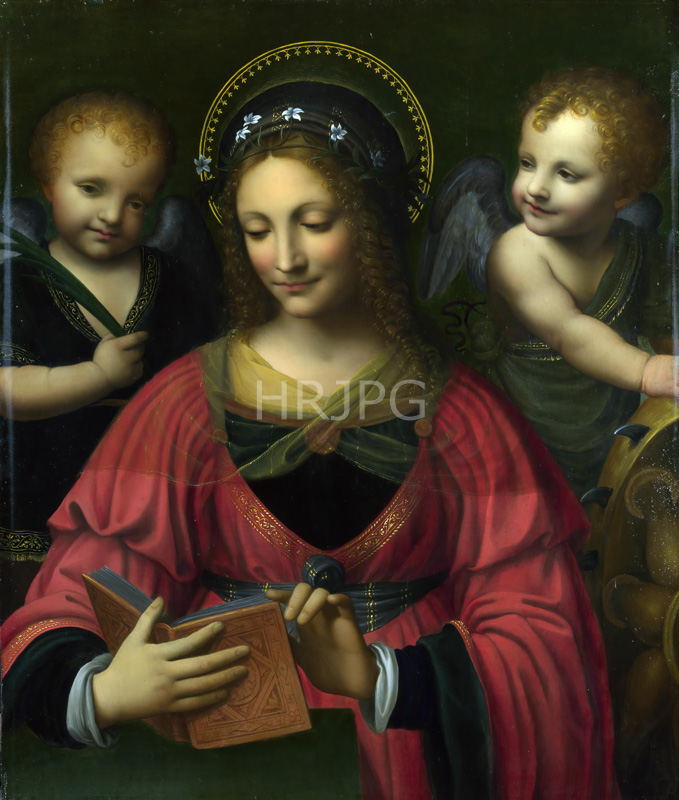
Bernardino Luini’s "Saint Catherine between Two Angels" is a masterpiece of his late period, showcasing the peak of his "Leonardesque" grace and his ability to create scenes of profound spiritual serenity. Saint Catherine of Alexandria, the legendary princess-martyr and patron of philosophers, is depicted seated and focused on a prayer book. She is flanked by two youthful, curly-haired angels who crown her with floral wreaths, symbolizing her divine victory and intellectual purity. This composition is a "sacra conversazione" of sorts, characterized by a quiet, rhythmic harmony that was Luini’s trademark. The influence of Leonardo da Vinci is visible in the soft "sfumato" transitions and the idealized beauty of the figures, yet the overall mood is one of accessible, domestic sweetness.
The figure of Saint Catherine is modeled with an extraordinary delicacy. Luini uses a diffused, gentle light to highlight the smooth planes of her face and the intricate folds of her rich green and red gown. Her expression is one of deep, interior focus, reflecting the Renaissance ideal of the virtuous and learned woman. The two angels are rendered with the soft, androgynous beauty favored by the Vinci workshop, their floral wreaths and serene gazes adding to the dreamlike, celestial atmosphere of the scene. The landscape in the far background features the typical "Leonardesque" blue mountains and misty paths, providing a sense of cosmic vastness that anchors the intimate narrative. The foreground is often populated with carefully observed botanical details, reflecting the era's interest in the scientific study of nature as a reflection of the divine.
Technically, the work is a tour de force of oil painting on panel. Luini’s brushwork is fluid and precise, capturing the varied textures of the silken robes, the metallic glint of the crown, and the soft, downy feathers of the angels' wings. This painting was likely intended for a private chapel or the study of a high-ranking Milanese patron who valued both the theological significance of the saint and the aesthetic perfection of the Lombard style. During the late 1520s, Luini’s popularity was at its height, as he successfully balanced the intellectual rigor of the High Renaissance with a lyrical, almost poetic sensibility that resonated with the cultural elite of Milan.
Today, this work (housed in the Hermitage or the National Gallery) remains one of the most beloved examples of the "Leonardeschi" tradition. It demonstrates how Luini perfected a visual language of peace and harmony that survived long after the political turbulence of the era. The painting stands as a testament to his status as the primary guardian of the "sweet" Vinci style, translating the master’s radical innovations into an enduring and universally admired vision of sacred beauty and human dignity.