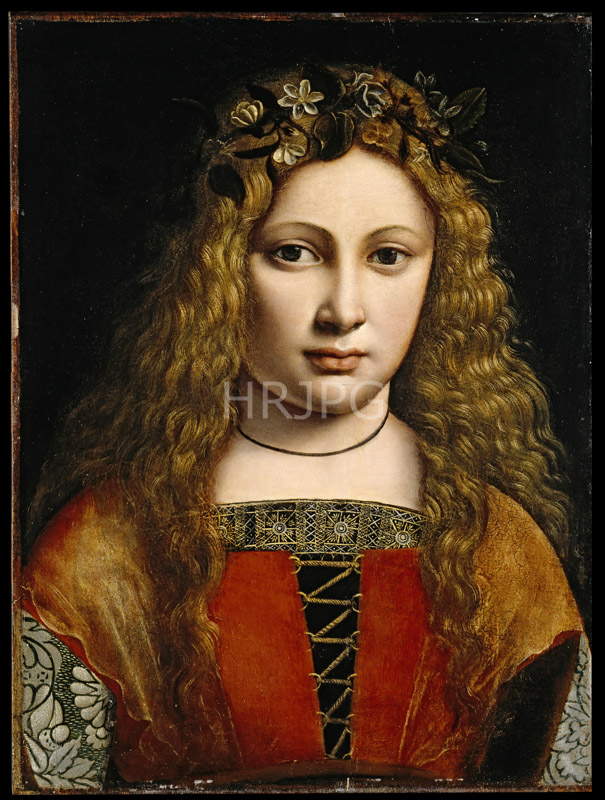
Giovanni Antonio Boltraffio’s "Portrait of a Youth Crowned with Flowers" is a quintessential example of the "Milanese School" search for idealized beauty and psychological poise. Boltraffio, who was perhaps the most technically gifted of Leonardo da Vinci’s Milanese pupils, specialized in portraits that blended the master’s "sfumato" with a distinctive sense of crystalline clarity and aristocratic reserve. In this painting, a beautiful young boy with long golden hair is shown facing the viewer, wearing a crown of white and pink flowers. This attribute suggests a variety of meanings: he may be an allegorical representation of the god of spring, a poetic figure of youthful innocence, or a member of the Milanese court participating in a festive or theatrical event.
The youth’s face is a study in High Renaissance proportion and divine grace. Boltraffio uses ultra-thin oil glazes to model the soft transitions of light across the forehead and cheeks, giving the skin a luminous, porcelain-like quality. The large, dark eyes look directly at the viewer with a calm, focused gaze that creates an immediate sense of intimacy. The individual curls of his golden hair and the delicate textures of the flower petals are rendered with a scientific precision that reflects Boltraffio’s training in Leonardo’s workshop. He wears a simple red tunic with white ties, a bold splash of color that is set against the stark, dark background. This "chiaroscuro" forces the viewer to focus entirely on the sculptural volume of the figure and the subtle, "Vinci-style" smile that plays on his lips.
Technically, the painting is characterized by a high degree of finish and a sophisticated use of color temperature. The warm tones of the face and tunic are balanced by the cool, pale whites of the flowers and the white ties of the garment. This visual harmony reflects the intellectual and aesthetic climate of Milan under the Sforza family, where art was used to project an image of cultural sophistication and divine order. While Boltraffio is often seen as a follower, this work demonstrates his unique ability to create images of "cold beauty" that are both technically perfect and psychologically engaging. It represents a peak moment in the development of the "ideal portrait," where the specific individual is transformed into a universal icon of youthful grace.
Today, this portrait (versions of which are found in the National Gallery of Art and other prestigious collections) remains one of the most admired examples of the "Leonardeschi" tradition. it serves as a vital document of the artistic legacy of Leonardo in Milan and continues to fascinate viewers with its combination of physical allure and quiet, contemplative power. It stands as a testament to Boltraffio’s status as a master in his own right, capable of taking the radical innovations of his teacher and refining them into a visual language of peak elegance and enduring popularity.