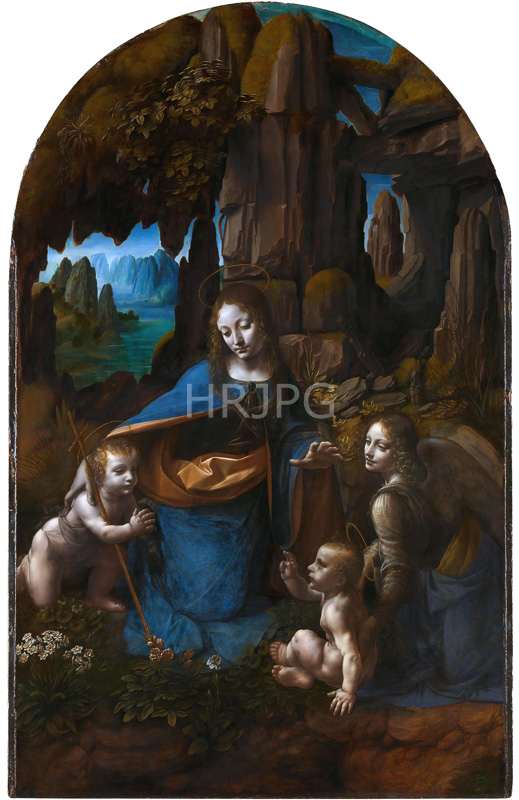
Leonardo da Vinci’s "Virgin of the Rocks" (the London version) is a milestone in High Renaissance art, representing the master’s obsession with geological science, complex narrative, and the revolutionary technique of "sfumato." This painting was commissioned as part of a large altarpiece for the Church of San Francesco Grande in Milan. The scene depicts the legendary meeting between the infant Christ and the young Saint John the Baptist in a mysterious wilderness during the Flight into Egypt. At the center of the composition is the Virgin Mary, whose protective gesture unifies the group. Beside her, an angel gazes at the viewer, pointing toward the Baptist. The figures are arranged in a stable yet dynamic pyramidal structure, a compositional innovation that became a standard for the High Renaissance.
The most striking element of the work is the "grotto" setting—a dense, primeval landscape of jagged, meticulously rendered rocks and exotic botanical species. This setting is not merely decorative but a reflection of Leonardo’s deep studies into the origins of the earth and the erosion caused by water. The "sfumato" is applied with extraordinary subtlety, where the figures seem to emerge from and dissolve into the damp, misty atmosphere of the cavern. The light appears to filter through the cracks in the rocks, creating a sense of divine mystery and profound psychological depth. In this version, unlike the earlier Louvre painting, the figures are given traditional haloes and the Baptist is given a cross, likely to satisfy the requirements of the religious patrons after years of legal disputes over the commission.
The interaction between the holy family is characterized by a quiet, monumental gravity. The infant Christ raises his hand in a gesture of blessing toward Saint John, who kneels in adoration, while the Virgin’s hand hovers protectively above her son’s head. This intergenerational dialogue is rendered with a level of anatomical precision and psychological insight that was unprecedented. Leonardo’s interest in optics and the movement of light is evident in the way shadows fall across the complex folds of the drapery and the translucent skin of the infants. The distant landscape, visible through the openings in the grotto, uses "aerial perspective" to create a sense of vast, unreachable space, suggesting the cosmic scale of the sacred event.
As a cornerstone of the National Gallery’s collection, the "Virgin of the Rocks" remains one of the most influential and studied paintings in Western art. It demonstrates Leonardo’s belief that art and science were inseparable, where the "imitation of nature" was the ultimate path to understanding the divine. The work’s combination of mathematical proportion, scientific observation, and spiritual mystery transformed the traditional theme of the Madonna into a profound meditation on the origins of life and the nature of faith. It stands as a supreme achievement of the Milanese Renaissance and a testament to Leonardo’s universal genius.