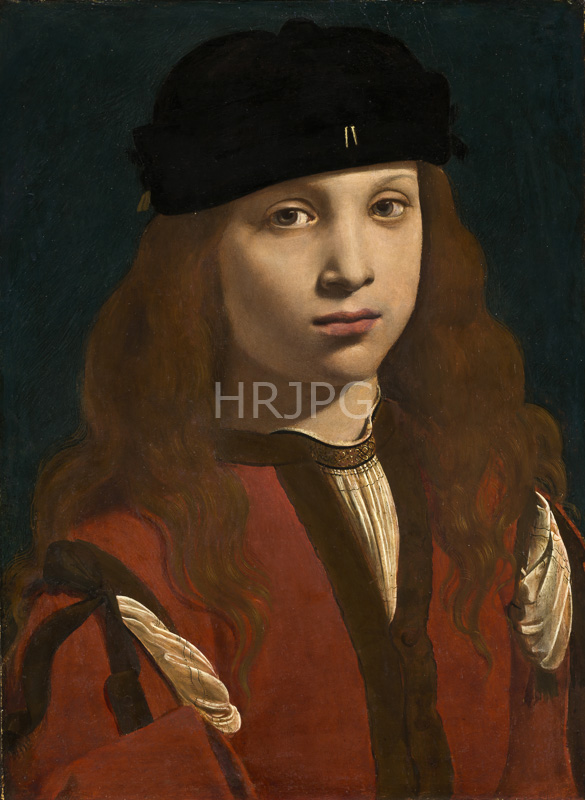
Giovanni Antonio Boltraffio’s "Portrait of a Youth" is a quintessential example of the "noble beauty" that defined the Milanese Renaissance under the influence of Leonardo da Vinci. Boltraffio, arguably the most talented and socially prominent of Leonardo’s pupils, specialized in creating portraits that combined the master’s atmospheric "sfumato" with a distinctive sense of crystalline clarity and aristocratic poise. In this work, a young boy with long, reddish-brown hair is depicted in a three-quarter turn against a stark, dark background. He wears a black cap and a vibrant red doublet adorned with delicate white ties, a splash of color that emphasizes the porcelain-like quality of his skin and the calm, focused gaze of his dark eyes.
The technical execution of the face is a masterclass in the "Leonardeschi" style. Boltraffio employs ultra-thin layers of oil glazes to achieve incredibly soft transitions between light and shadow, particularly around the jawline and the corners of the mouth. This creates a sense of living flesh and three-dimensional volume without the use of harsh outlines. The youth’s expression is one of quiet, interior intelligence, reflecting the intellectual and cultural sophistication of the Milanese court under the Sforza family. The individual strands of his hair and the fine texture of the white ties are rendered with a scientific precision that mirrors Leonardo’s own observations of nature, yet the overall effect is one of refined, decorative elegance.
During the late 15th century, the portrait served as a record of social status and individual character. Boltraffio’s youth is not merely a likeness but an idealized icon of the Renaissance spirit. The dark background, a common device in the Vinci circle, serves to eliminate distractions and project the figure forward into the viewer’s immediate psychological space. This creates an intimate connection between the sitter and the audience, a hallmark of High Renaissance portraiture. The subtle, enigmatic smile playing on the youth's lips further aligns the work with the psychological depth pioneered by his master.
Today, as part of the National Gallery’s collection in London, this portrait remains one of the most admired examples of Boltraffio’s skill. It demonstrates how Leonardo’s radical innovations were adapted and standardized by his followers to create a lasting visual language of grace and dignity. The painting stands as a testament to Boltraffio’s role as a primary guardian of the "Vinci brand," translating the master's complex theories into a visual language of peak elegance and enduring popular appeal. It remains a hauntingly beautiful reminder of the intellectual and aesthetic heights achieved in Milan during its golden age.