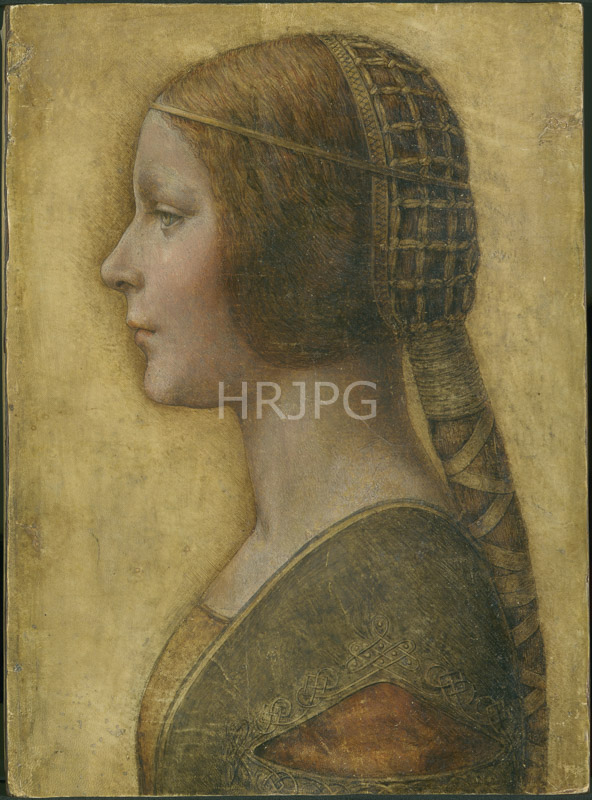
"La Bella Principessa" is one of the most fascinating and intensely debated works in recent art history. Originally thought to be an early 19th-century German work, it was re-identified in the early 21st century by several prominent scholars, including Martin Kemp, as an original work by Leonardo da Vinci. The portrait, executed in colored chalks and ink on vellum, is believed to depict Bianca Sforza, the illegitimate daughter of Ludovico il Moro, Duke of Milan. She is shown in a sharp profile, a pose that harkens back to the tradition of courtly medals and reflects the rigid social hierarchies of the Milanese court. Her hair is intricately bound in a "coazzone"—a long, braided ponytail encased in a silk sheath—which was the height of fashion in Milan during the 1490s.
The attribution to Leonardo is supported by the extraordinary technical refinement of the work. The "left-handed" hatching, characteristic of Leonardo’s unique drawing style, is visible in the modeling of the cheek and neck. The artist uses a combination of red, black, and white chalk to create subtle gradations of tone that give the skin a luminous, three-dimensional quality. The gaze of the young princess is particularly striking; it is characterized by a mixture of youthful innocence and a somber, almost melancholic maturity, fitting for a girl whose life was cut short shortly after her high-profile marriage. The meticulous rendering of the "da Vinci knot" patterns on her dress further suggests the master's involvement, as he was famously obsessed with complex interlacing designs.
The history of the work is as compelling as its technical merits. Research suggests the vellum was originally part of a luxury manuscript known as the "Sforziad," which celebrated the deeds of the Sforza family. The removal of the portrait from the book likely occurred in the 19th century. While the attribution remains a subject of heated controversy among some experts, the work’s combination of psychological depth and scientific precision aligns perfectly with Leonardo’s experiments during his first Milanese period. The profile view, while traditional, is imbued with a sense of interior life that was revolutionary for the time.
Today, "La Bella Principessa" is regarded by many as a vital addition to Leonardo’s limited surviving oeuvre. It represents a rare instance of the master working on vellum and provides a window into the intimate world of the Sforza court. The portrait stands as a monument to the fleeting beauty of youth and the enduring power of Renaissance draftsmanship. It continues to inspire scholars and the public alike, serving as a reminder that the mysteries of the past can still be unlocked through careful scientific and connoisseurial investigation. The work’s quiet dignity and technical perfection remain a supreme achievement of Italian High Renaissance art.