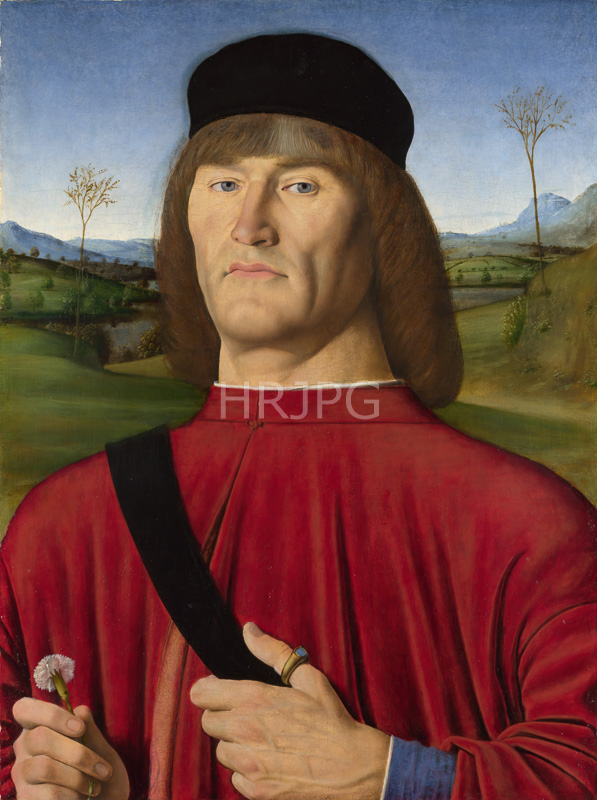
Andrea Solario’s "Man with a Pink Carnation" is a masterpiece of the early Lombard Renaissance, showcasing the artist’s unique ability to synthesize the atmospheric innovations of Leonardo da Vinci with the meticulous, tactile realism of the Northern European tradition. Solario, who was one of the most traveled of the "Leonardeschi," likely encountered Flemish or Venetian art early in his career, which informed his focus on sharp detail and brilliant color. In this portrait, a stern, middle-aged man with shoulder-length brown hair and a black cap is shown in a three-quarter turn. He wears a rich red robe over a black doublet, holding a pink carnation in his right hand. The carnation was a common Renaissance symbol of love, marriage, or even divine devotion, suggesting that the portrait may have been commissioned to commemorate a significant personal milestone.
The physical presence of the sitter is modeled with an extraordinary sense of volume and clarity. Solario uses a focused light source that emphasizes the varying textures of the skin—the slight wrinkles around the eyes, the individual strands of the hair, and the rough surface of the wooden parapet in the foreground. The influence of Leonardo is visible in the soft transitions around the mouth and the thoughtful, interior expression of the man. However, the background landscape reflects Solario’s preference for a more expansive and light-filled world than the typical dark interiors of the Vinci workshop. Winding paths, meticulously rendered trees, and a distant, misty lake recede toward a pale horizon, creating a profound sense of space and air through aerial perspective.
Technically, the painting is characterized by a high degree of finish and a harmonious color palette. The deep reds and blacks of the clothing are balanced by the cool tones of the landscape and the delicate pink of the flower. This visual harmony reflects the intellectual and aesthetic climate of the era, where art was used to project an image of dignity and moral character. Solario’s ability to capture the "weight" of the figure—both physically and psychologically—elevates the work beyond a mere record of appearance. The man’s steady, direct gaze creates an immediate connection with the viewer, inviting them to contemplate the personality behind the aristocratic facade.
As a key work in the National Gallery’s collection in London, "Man with a Pink Carnation" remains a vital example of Solario’s early mature period. It illustrates how Leonardo’s influence was transformed by his followers into a diverse and highly successful regional style that incorporated elements from across Europe. The painting stands as a testament to the high cultural sophistication of the patrons who commissioned such works and reflects Solario’s status as a leading figure in the Lombard Renaissance, an artist who could bridge the gap between different aesthetic traditions to create a unique and enduring vision of human dignity.