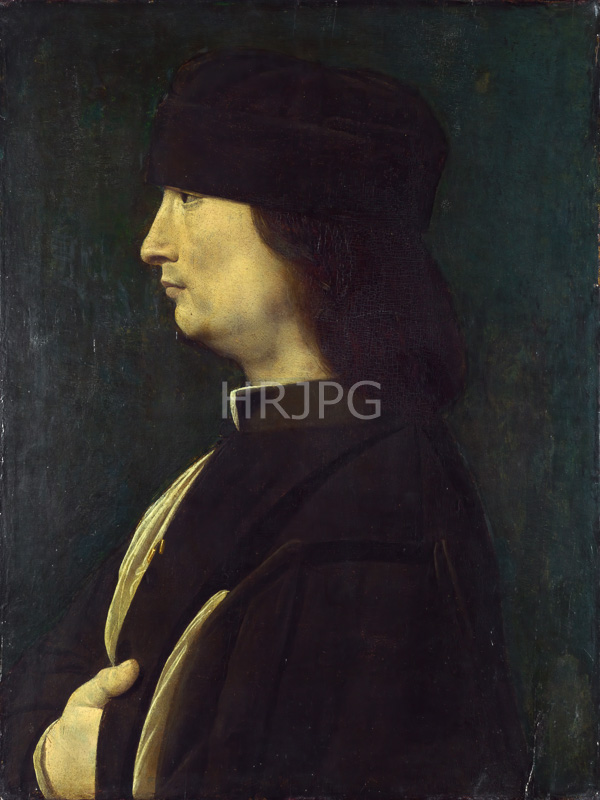
Giovanni Antonio Boltraffio’s "Portrait of a Man in Profile" is a stunning example of the refined elegance and technical precision that defined the Milanese school around the turn of the 16th century. Boltraffio, arguably the most sophisticated of Leonardo da Vinci’s pupils, often utilized the profile view to emphasize the noble character and rhythmic silhouette of his sitters. This format, rooted in the tradition of classical medals and early Renaissance court portraiture, allowed the artist to focus on the sharp clarity of line and the subtle modeling of the features. The subject, a man of noble bearing, is shown with a black cap and a dark, gold-trimmed garment, set against a plain, deep-green background that pushes the figure forward with a powerful sense of physical volume.
The modeling of the face is a masterclass in the application of "sfumato" within a linear framework. Boltraffio uses incredibly fine gradations of light and shadow to create the soft volume of the cheek, the noble arch of the nose, and the firm line of the jaw. This creates a lifelike presence that feels both solid and ethereal. The individual strands of the man’s long, dark hair are rendered with a scientific accuracy that reflects Boltraffio’s training in Leonardo’s workshop, yet the overall effect is one of idealized, crystalline beauty. The calm, focused expression of the sitter conveys a sense of psychological stillness and aristocratic reserve, hallmarks of the courtly style favored by the Sforza family in Milan.
The choose of the dark green background is particularly effective, providing a subtle color contrast to the warm flesh tones while maintaining a sense of quiet gravity. Unlike Leonardo, who often sought the mysterious and the hazy, Boltraffio prioritizes a sense of "cold beauty" and technical perfection. The light appears to glide over the surface of the painting, highlighting the varying textures of the skin and the fabric with a meticulousness that invites close inspection. This work reflects the shifting needs of portraiture in the High Renaissance, where the goal was not just to record a likeness but to create an image of eternal dignity and intellectual poise.
Today, as part of the National Gallery’s collection in London, this profile portrait remains one of the most studied examples of the "Leonardeschi" tradition. It demonstrates how Boltraffio perfected a visual language that was uniquely suited to the aristocratic tastes of his time. The painting stands as a testament to his status as a master in his own right, capable of taking the radical innovations of his teacher and refining them into a visual language of peak elegance and enduring popular appeal. It is a vital document for understanding the cultural and aesthetic height of the Milanese Renaissance during its final years of independence.