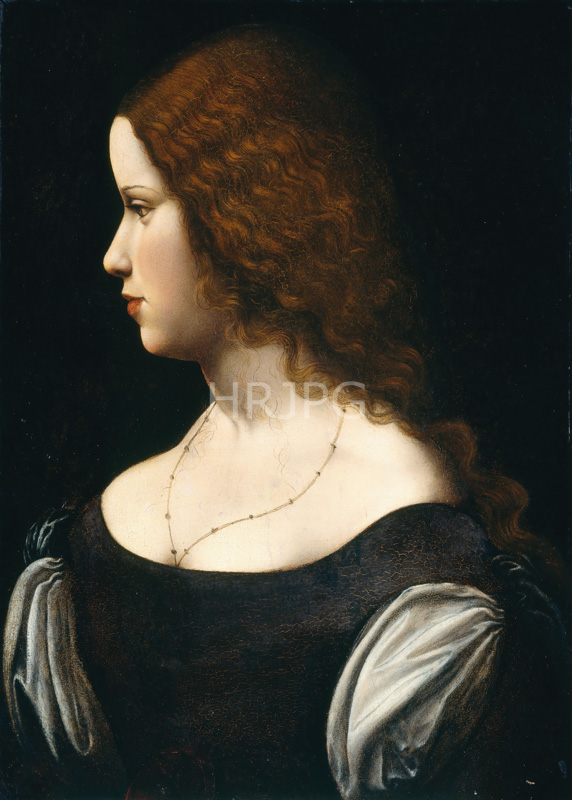
This "Portrait of a Young Lady," housed in the National Gallery of Art in Washington, D.C., is a beautiful and evocative example of the "Leonardeschi" style that dominated Milanese art at the turn of the 16th century. Though the specific hand of the artist remains a subject of debate—with attributions ranging from Bernardino de' Conti to a talented anonymous pupil—the work perfectly embodies the aesthetic of Leonardo da Vinci's circle. The lady is shown in a three-quarter turn, her pensive expression and downward gaze reflecting the psychological interiority that Leonardo pioneered. She wears a striking black gown with vibrant blue puffed sleeves and intricate gold embroidery, reflecting the high fashion and material luxury of the Milanese court.
The modeling of the figure is achieved through a sophisticated use of "sfumato," particularly in the soft transitions across her forehead and around her eyes. This gives her skin a luminous, porcelain-like quality and a sense of three-dimensional volume. Her long, reddish-brown wavy hair is bound by a thin black headband, a style that reflects the refined elegance of the era. The thin gold necklace around her neck adds a subtle touch of wealth and status. The background is a stark, dark void, a common device in the Vinci workshop that serves to eliminate all distractions and force the viewer to focus entirely on the sitter’s character and presence. This dramatic use of "chiaroscuro" projects the figure into the viewer’s space, creating an intimate, meditative connection.
Technically, the painting showcases the high standards of the Milanese school. The rendering of the varied textures—from the heavy silk of the gown to the fine, individual strands of the hair—demonstrates a commitment to the "imitation of nature." The psychological tone of the work is one of quiet, almost melancholic contemplation, suggesting a complex inner life that remains inaccessible to the viewer. This sense of mystery and grace is what made the Leonardesque style so popular among the European aristocracy. The work demonstrates how the master's radical innovations were adapted and standardized by his followers to create a lasting visual language of dignity and aristocratic reserve.
Historically, this portrait serves as an important record of the cultural sophistication of Milan during the reign of Ludovico il Moro. It reflects a period when art was used to project an image of power, beauty, and intellectual depth. The "Portrait of a Young Lady" continues to captivate scholars and the public for its combination of technical perfection and haunting emotional presence. It remains a vital piece of the Leonardesque puzzle, standing as a monument to the enduring power of the Vinci style and its ability to transform a traditional likeness into a profound exploration of the human soul.