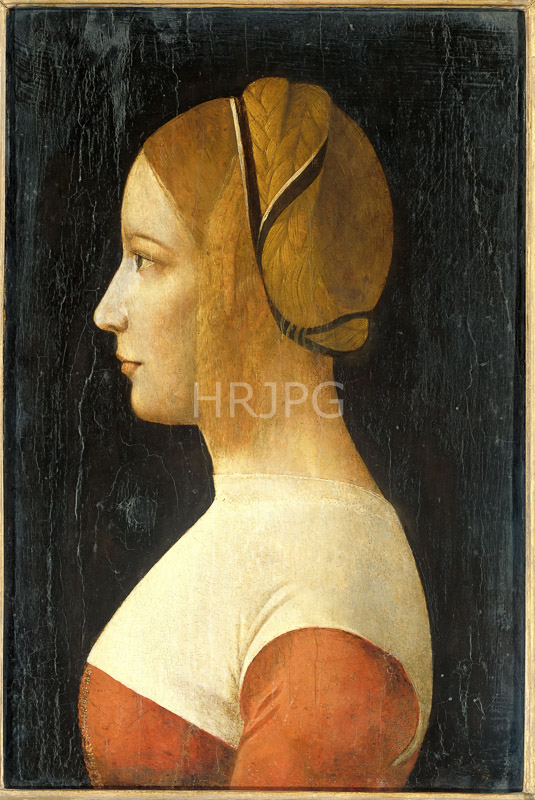
Giovanni Ambrogio de Predis’s "Portrait of a Lady," often identified as Beatrice d'Este, Duchess of Milan, is one of the most famous and refined examples of the Milanese profile tradition. De Predis was the primary court painter for the Sforza family and a close associate of Leonardo da Vinci, and this portrait reflects the high cultural standards of the court under Ludovico il Moro. The sitter is shown in a sharp, pure profile, a format that emphasizes her noble lineage and the exquisite details of her attire. She wears a cream-colored dress with vibrant red sleeves, adorned with intricate gold embroidery and a delicate headband with a jewel that secures her hair. The profile view, rooted in the tradition of classical medals, projects an image of aristocratic reserve and eternal poise.
The technical execution of the work is characterized by a high degree of linear precision and a focus on luxurious materials. De Predis models the face with a soft, focused light that highlights the smoothness of the skin and the rhythmic silhouette of the features. While he lacks the profound psychological depth of Leonardo, de Predis captures the tactile reality of the jewels and fabrics with remarkable clarity. The individual pearls and the fine gold thread are rendered with a meticulousness that reflects the artist’s training in the decorative arts. The dark, monochromatic background serves to project the figure forward, making her physical presence and social status the central focus of the viewer’s gaze.
Beatrice d’Este was a legendary figure of the Renaissance, known for her patronage of the arts and her brilliant, though short-lived, court. This portrait captures the ideal of the "Renaissance princess"—highly educated, impeccably dressed, and possessing a quiet, monumental dignity. The use of the profile was a deliberate choice to align the Sforza court with the great rulers of antiquity. The influence of Leonardo is visible in the idealized features and the soft treatment of the hair, but the overall design remains firmly within de Predis’s own formal and decorative style. The painting provides a fascinating window into the material wealth and aesthetic aspirations of the Milanese court during its final years of glory.
Today, as a centerpiece of the Pinacoteca Ambrosiana in Milan, this "Portrait of a Lady" remains one of the most admired works of the Lombard Renaissance. It demonstrates how de Predis successfully balanced the demands of courtly likeness with the emerging High Renaissance interest in idealized beauty. The painting stands as a testament to the high technical skill and cultural sophistication of the Milanese school, serving as an enduring icon of one of history’s most vibrant and influential courts. It remains a hauntingly beautiful reminder of the power of art to preserve the memory of an era and the individuals who shaped it.