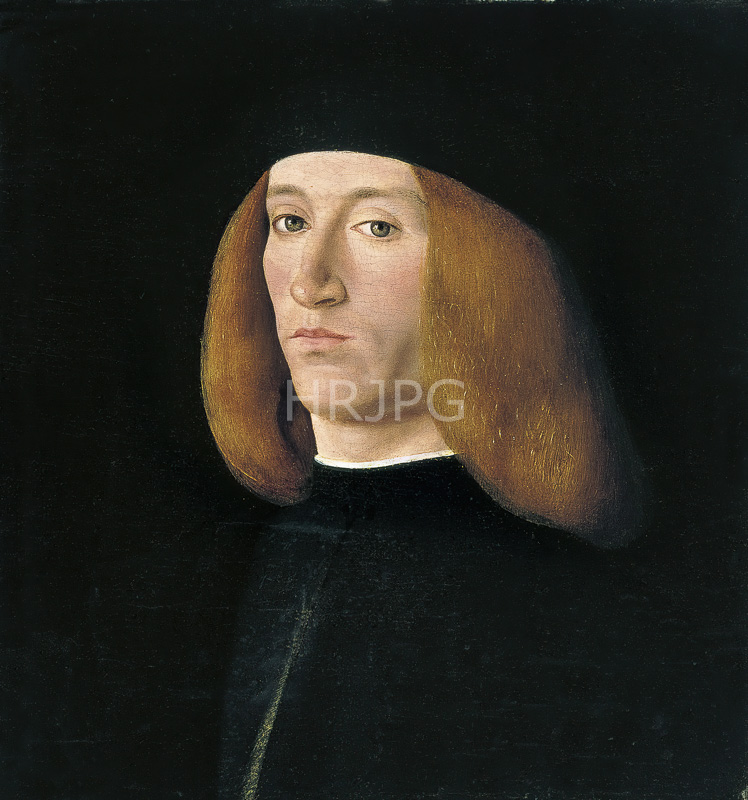
Andrea Solario’s "Portrait of a Young Man" is a profound and technically refined exploration of psychological interiority, representing the peak of his early Milanese style. Solario, who was deeply influenced by Leonardo da Vinci’s innovations, managed to synthesize the master's soft "sfumato" with his own penchant for direct, visceral realism. In this work, a pensive young man with long, reddish-brown hair and a black cap is shown in a three-quarter turn against a stark, plain background. His gaze is directed toward the viewer, but it possesses a detached, contemplative quality that suggests a complex inner life. This focus on the "movements of the mind" is a direct result of Solario’s engagement with Leonardo’s revolutionary theories on portraiture.
The modeling of the face is achieved through ultra-thin oil glazes, creating incredibly soft transitions between light and shadow. Solario uses a focused light that highlights the noble planes of the forehead and the smooth texture of the skin, giving the figure a powerful three-dimensional presence. The individual strands of the hair and the delicate features of the eyes and mouth are rendered with a scientific precision that reflects Solario’s mastery of his medium. Unlike the more decorative court portraits of his contemporaries, Solario’s young man possesses a raw, human quality that is both intimate and monumental. The dark background serves to eliminate all distractions, forcing the viewer to confront the sitter’s presence and character directly.
Technically, the painting showcases Solario’s unique position as a bridge between the Italian and Northern European traditions. The clarity of the detail and the focused light reflect the influence of Flemish masters, while the idealized beauty and atmospheric depth are firmly rooted in the Milanese Renaissance. This visual harmony reflects the intellectual and aesthetic climate of the era, where art was used to explore the depths of human personality and the mysteries of the soul. The youth’s expression—a subtle blend of sadness and dignity—creates an immediate and lasting emotional connection with the viewer, a hallmark of the High Renaissance transition from a record of status to a record of self.
Now housed in the Museum of Fine Arts, Boston, this portrait remains one of the most admired examples of Solario’s early skill. It demonstrates how Leonardo’s influence was transformed by his most talented followers into a diverse and highly successful regional style. The painting stands as a testament to Solario’s status as a leading figure in the Lombard Renaissance, an artist who could capture the ephemeral qualities of human thought and emotion through a visual language of peak elegance and technical perfection. It continues to fascinate scholars and the public for its haunting beauty and its profound psychological depth.