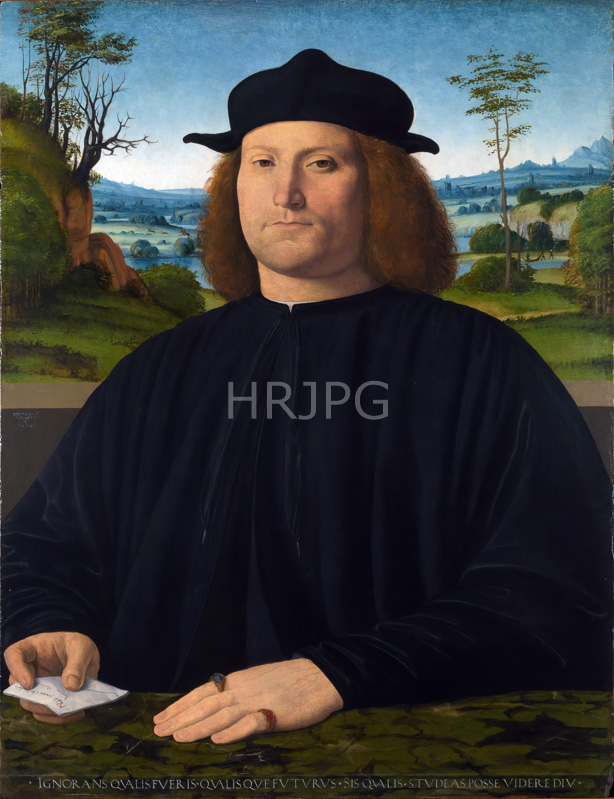
Andrea Solario’s "Portrait of Giovanni Cristoforo Longoni" is a masterpiece of High Renaissance portraiture, showcasing the artist’s full maturity and his ability to combine social status with profound psychological insight. The sitter, Giovanni Cristoforo Longoni, was a high-ranking cleric and the treasurer of Milan Cathedral, a position of significant power and prestige. Solario depicts him in a formal, three-quarter turn, wearing the black hat and robe of his office. He holds a letter, a device that both identifies his professional role and provides a focus for his hands. The portrait is set against an expansive, atmospheric landscape featuring winding paths, dense trees, and blue-tinted mountains, reflecting Solario’s mastery of aerial perspective and his love for the Northern Italian environment.
The physical presence of Longoni is modeled with a startling clarity and volume. Solario uses a focused light that highlights the individual features of the face—the slight double chin, the intense gaze, and the textured skin of an aging man. This focus on realistic detail, likely influenced by Solario’s exposure to Flemish and Venetian art, creates a sense of living presence that was revolutionary for the time. However, the influence of Leonardo is visible in the soft transitions around the eyes and the thoughtful, interior expression that suggests a man of great intellectual weight and moral character. The landscape in the background recedes into a hazy, blue horizon, creating a sense of vast space that provides a monumental context for the sitter.
Technically, the painting is characterized by a high degree of finish and a sophisticated use of color. The deep blacks of the robes are set against the vibrant greens and blues of the landscape, creating a visual harmony that is both striking and contemplative. The individual strands of hair and the fine texture of the letter are rendered with a scientific precision that reflects Solario’s technical mastery. During the early 16th century, such portraits were intended to preserve the likeness and the character of the sitter for future generations, and Solario’s version stands as one of the most successful examples of the era. The work reflects the high cultural sophistication of the Milanese elite and the importance of professional status during the Renaissance.
As a cornerstone of the National Gallery’s collection in London, this portrait remains one of the most studied works of the Milanese school. It illustrates how Solario successfully balanced the demands of institutional likeness with the emerging High Renaissance interest in human personality and the natural world. The painting stands as a testament to Solario’s role as a primary bridge between different European artistic traditions and his ability to imbue traditional portraiture with a new sense of High Renaissance monumentality and psychological depth. It is a vital document for understanding the intersection of faith, power, and art in 16th-century Milan.