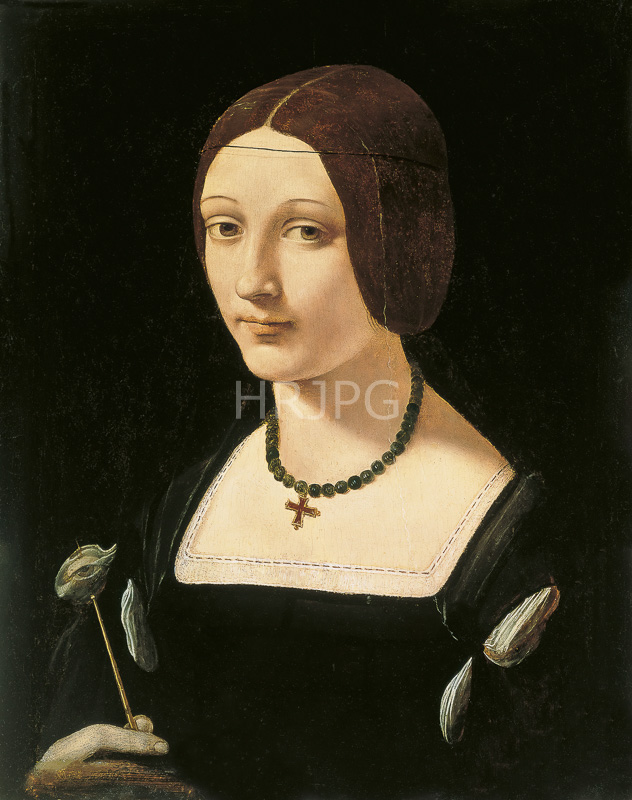
Giovanni Antonio Boltraffio’s "Portrait of a Lady as Saint Lucy" is a sophisticated and technically brilliant example of the Renaissance practice of "portraiture in guise," where a noblewoman is depicted with the attributes of a saint to emphasize her virtues or her namesake. In this painting, a noble lady from the Milanese court is shown as Saint Lucy, holding a flower—likely a pink carnation or a jasmine—which symbolizes her beauty and her spiritual devotion. She wears a rich black gown with a high waist, adorned with a jewel-encrusted cross necklace, reflecting the high fashion and religious piety of the era. Boltraffio, who was Leonardo da Vinci’s most aristocratic pupil, imbues the work with a sense of "cold beauty" and technical perfection that was his signature.
The modeling of the lady’s face is a masterclass in the application of "sfumato." Boltraffio employs ultra-thin layers of oil glazes to achieve a seamless transition between light and shadow, giving her skin a luminous, porcelain-like quality. Her expression is one of serene, detached intelligence, with the characteristic "Vinci smile" hinting at a complex inner life. Her hair is neatly braided and styled in the Milanese fashion, reflecting the refined elegance favored by the Sforza court. The dark, monochromatic background serves to project the figure forward, making her physical presence and the intricate details of her attire the central focus of the viewer’s attention. This dramatic use of "chiaroscuro" creates a powerful three-dimensional volume, as if the lady were emerging into the viewer’s space.
The choice of Saint Lucy, often associated with light and vision, adds a layer of intellectual depth to the portrait. During the Renaissance, such images were intended for private display, serving as both a likeness of the individual and an icon of divine grace. Boltraffio’s ability to combine physical realism with an idealized, spiritual perfection reflects the High Renaissance synthesis of the human and the divine. The technical finish of the work is exceptionally high, with smooth, enamel-like surfaces that have preserved the vibrancy of the pigments over the centuries. Boltraffio was not merely an imitator of Leonardo but an artist who developed his own distinct aesthetic, blending the master's lighting with a Northern Italian focus on material luxury and social status.
Now housed in the Thyssen-Bornemisza Museum in Madrid, this portrait remains one of the most admired examples of the "Leonardeschi" tradition. It demonstrates how Leonardo’s radical innovations were adapted and standardized by his most talented followers to create a lasting visual language of dignity and grace. The "Portrait of a Lady as Saint Lucy" stands as a testament to Boltraffio’s status as a master in his own right, an artist who could capture the ephemeral qualities of human personality through a visual language of peak elegance and technical refinement. It continues to intrigue scholars and art lovers alike for its combination of haunting emotional presence and hidden symbolic meaning.