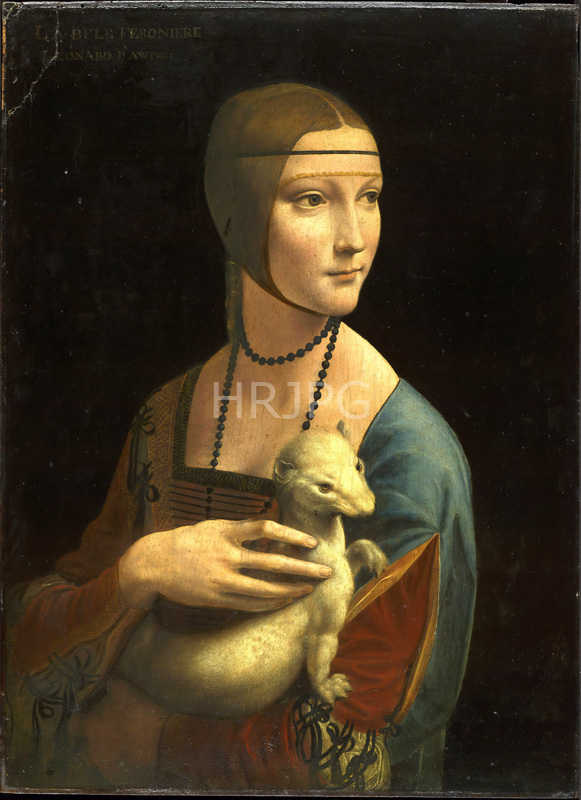
Leonardo da Vinci’s "Lady with an Ermine" is a supreme masterpiece of the High Renaissance, representing a revolutionary moment in the history of portraiture. Painted during Leonardo’s first Milanese period, it depicts Cecilia Gallerani, the young and highly intellectual mistress of Ludovico Sforza, the Duke of Milan. The portrait is celebrated for its innovative three-quarter turn, where the sitter’s head is turned in a different direction than her body, suggesting a sudden movement or a reaction to an off-canvas presence. This "motion of the mind" (moti mentali) was a core tenet of Leonardo’s artistic philosophy, imbuing the static image with a sense of living, breathing consciousness. Cecilia’s expression is one of refined, detached intelligence, her gaze directed toward an unknown point that invites the viewer to speculate on her thoughts.
The central focal point of the painting is the white ermine held in Cecilia’s arms. The animal serves a dual symbolic purpose: it is an emblem of purity and moderation, as legend stated that an ermine would rather die than soil its white coat. Simultaneously, it acts as a subtle pun on Cecilia’s surname (Gallerani sounding like the Greek word for ermine, "galee") and a tribute to Ludovico Sforza, who was a member of the Order of the Ermine. Leonardo’s scientific curiosity is visible in the anatomical precision of the ermine’s muscular body and Cecilia’s long, elegant fingers. The use of "sfumato" is masterfully applied to the modeling of the skin, creating soft, rhythmic transitions of light and shadow that give the sitter a luminous, porcelain-like quality. The dark background serves to project the figure forward, heightening the emotional and physical intimacy of the portrait.
Technically, the work showcases Leonardo’s early mastery of the oil medium, allowing for a level of detail and atmospheric depth that was far superior to traditional tempera. The individual strands of hair and the fine texture of the black necklace and embroidered garments are rendered with a scientific precision that reflects Leonardo’s lifelong obsession with the "imitation of nature." The lighting appears to originate from a focused source, highlighting the subtle contours of Cecilia’s forehead and neck. This portrait redefined the genre, moving away from the flat, formal profile toward a profound exploration of human personality and social status. As a cornerstone of the Czartoryski Museum in Krakow, it remains one of the most studied and admired images in Western art, standing as a testament to Leonardo’s universal genius and his ability to capture the soul within the flesh.