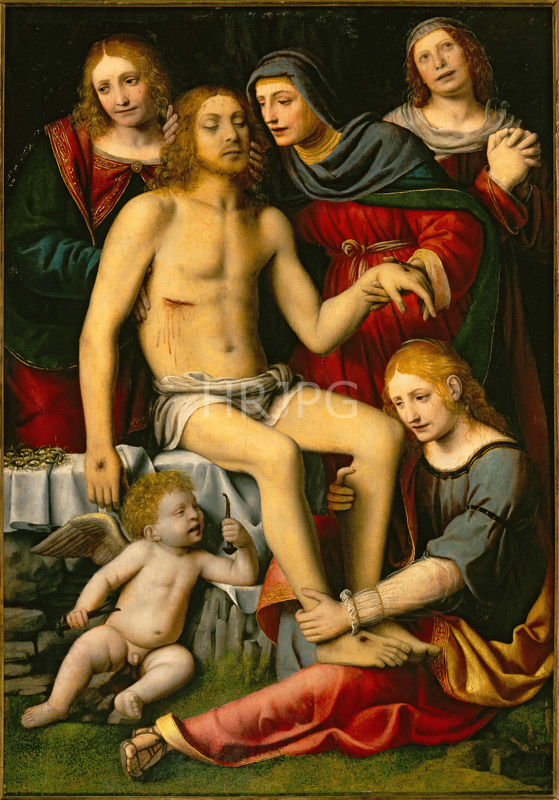
Bernardino Luini’s "Lamentation over the Dead Christ" is one of his most emotionally profound and technically refined works, representing the culmination of his engagement with the High Renaissance style. Painted during his final decade, the work depicts the immediate aftermath of the Crucifixion, with the body of Christ supported by the Virgin Mary and surrounded by a group of weeping figures, including Saint John the Evangelist and Mary Magdalene. Luini manages to imbue this scene of intense grief with a pervasive sense of "dolcezza"—a characteristic sweetness and poise that prevents the tragedy from becoming overwhelmingly grotesque. The composition is organized with a rhythmic, almost sculptural clarity, where each figure’s posture and expression contributes to a unified sacred narrative.
The dead Christ is modeled with an extraordinary sense of anatomical volume and tactile realism. Luini uses a soft, focused light that highlights the pale, luminous skin of the savior, contrasting it with the vibrant, jewel-toned robes of the surrounding figures. Christ’s face is a vision of divine resignation, his features smoothed by death into a state of eternal peace. The Virgin Mary’s expression is one of profound, interior sorrow, her downcast eyes and gentle support of her son reflecting the Renaissance ideal of maternal dignity. Saint John and Mary Magdalene are depicted with expressive hand gestures and focused gazes that invite the viewer into the emotional core of the scene. The use of "sfumato" is masterfully applied to the transitions between light and shadow, giving the figures a tangible physical presence within the atmospheric space.
Technically, the painting showcases Luini’s mastery of the oil medium on a grand scale. The textures—from the heavy silk of the garments to the individual strands of hair and the rough wood of the cross in the background—are rendered with a precision that reflects the high standards of the Milanese school. The landscape, while somber and focused, features the typical "Leonardesque" blue mountains and misty paths, suggesting a cosmic scale for the sacrifice. This work was likely intended for a prominent church or the private chapel of a noble family, serving as a powerful object for meditation and prayer. Luini’s "Lamentation" stands as a monument to his status as the primary successor of Leonardo’s legacy in Lombardy, an artist who could capture the deepest mysteries of faith through a visual language of peak elegance and profound human relevance.