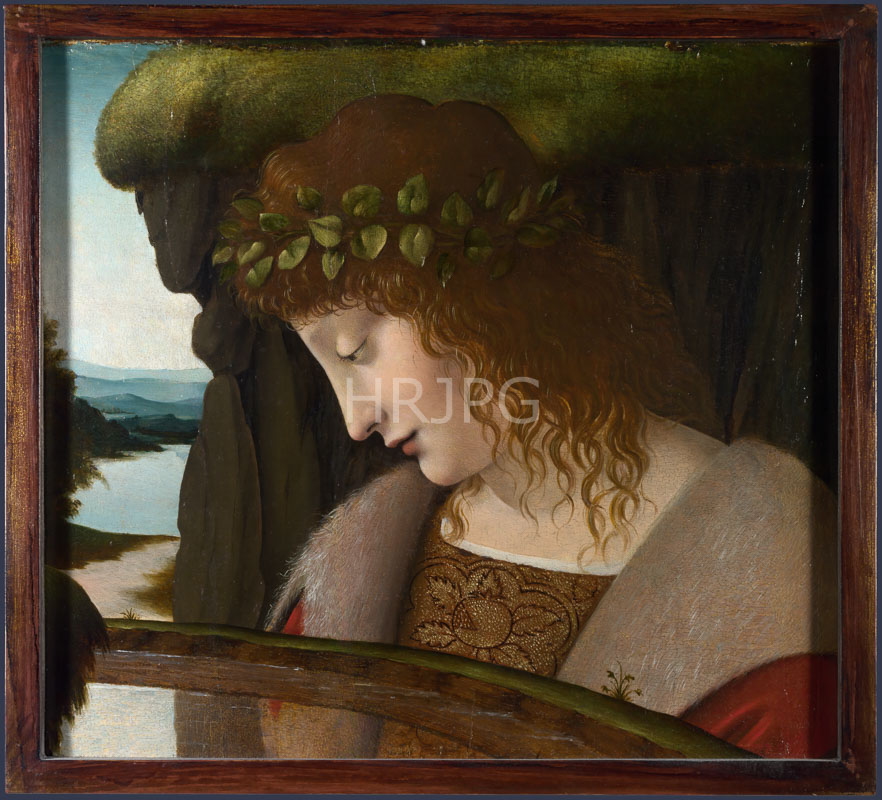
This hauntingly beautiful painting of "Narcissus" is a quintessential example of the "Leonardeschi" focus on idealized beauty and the exploration of psychological states. Attributed to a talented follower of Giovanni Antonio Boltraffio (and formerly to Boltraffio himself), the work depicts the mythological youth who fell in love with his own reflection. Narcissus is shown in a three-quarter turn, his head bowed as he gazes down into a dark, still pool of water. He wears a crown of delicate flowers and a simple, dark garment that emphasizes the luminous, porcelain-quality of his skin. The composition is characterized by a profound sense of stillness and self-absorption, perfectly capturing the tragic essence of the myth.
The modeling of the youth’s face is achieved through an exceptional use of "sfumato." The transitions between light and shadow around the eyes and the corner of the mouth are so soft that they appear like smoke, giving the figure a dreamlike, ethereal quality. This "Leonardesque" grace is a direct homage to the master’s studies of idealized human forms. The reflection in the pool—a subtle, ghostly repetition of the face—is a marvel of Renaissance optics, suggesting the fluidity between the real and the imagined. The dark, impenetrable background serves to project the figure forward, heightening the emotional intimacy of the scene and focusing the viewer’s attention on the youth’s fatal self-obsession. The individual petals of the floral crown and the fine texture of the hair are rendered with a scientific precision that reflects the high standards of the Milanese school.
During the Renaissance, the myth of Narcissus was often used as a cautionary tale about the dangers of vanity and the transient nature of physical beauty. However, in the hands of the Boltraffio circle, it becomes a study in "noble beauty" and poetic melancholy. The work reflects the intellectual and aesthetic climate of Milan under the Sforza family, where art was used to explore the depths of human personality and the mysteries of the soul. Technically, the smooth, enamel-like finish of the oil-on-panel demonstrates the artist’s mastery of his medium and his ability to imbue a secular subject with a sense of eternal, crystalline grace. This "Narcissus" (found in the National Gallery or similar institutions) remains one of the most admired examples of the "Milanese School" legacy, serving as an enduring icon of the High Renaissance search for the ideal.