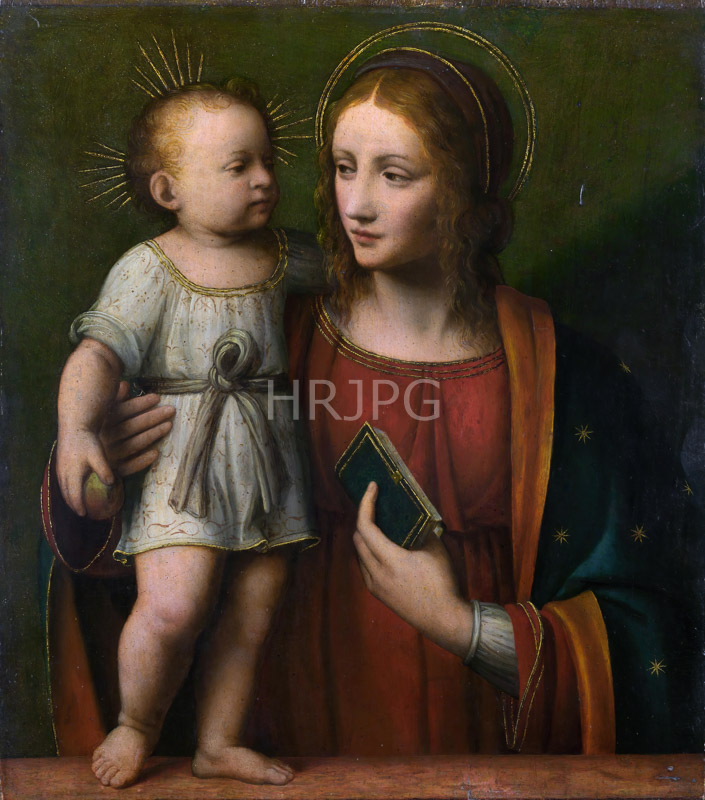
Bernardino Luini’s "The Virgin and Child" is a supreme example of the "sweet" style that made him the preeminent popularizer of Leonardo da Vinci’s innovations in 16th-century Lombardy. This panel, created during Luini’s full maturity, captures a moment of quiet maternal joy and divine grace. The Virgin Mary is depicted in a vibrant red gown and translucent white chemise, supporting the infant Christ who stands beside her. The child is dressed in a delicate, semi-transparent white tunic and holds a small prayer book, a device that foreshadows his future role as the Word made flesh. The interaction between mother and son is characterized by a profound sense of domestic peace and monumental dignity, reflecting the High Renaissance synthesis of the human and the divine.
The figure of the Virgin is modeled with Luini’s characteristic softness, her face an idealized vision of "Leonardesque" beauty—downcast eyes, a straight, noble nose, and a subtle, enigmatic smile. The use of "sfumato" is masterfully applied to the transitions of light and shadow, giving her skin a luminous, porcelain-like quality. The infant Christ is rendered with a remarkable naturalism, his chubby, realistic anatomy and pensive expression reflecting the scientific studies of human growth pioneered by Leonardo. The lighting is soft and diffused, appearing to emerge as if from a divine source to highlight the delicate textures of the hair and the complex folds of the drapery. The dark, monochromatic interior background serves to project the figures forward, making their physical volume and emotional connection the central focus of the viewer’s gaze.
Technically, the painting showcases Luini’s mastery of the oil medium and his commitment to the "imitation of nature." The individual strands of the Christ child’s golden hair and the intricate patterns of the Virgin’s embroidery are rendered with a precision that reflects the high standards of the Milanese school. During the Renaissance, such images were highly sought after for private devotion, providing the viewer with a beautiful and emotionally resonant object for meditation. Luini’s ability to take the master's radical intellectualism and transform it into a visual language that was accessible and universally admired was the key to his lasting legacy. This work remains a vital document of the Lombard Renaissance, standing as a monument to Luini’s genius for storytelling and his ability to capture the "sweetness" and eternal grace of the High Renaissance spirit.