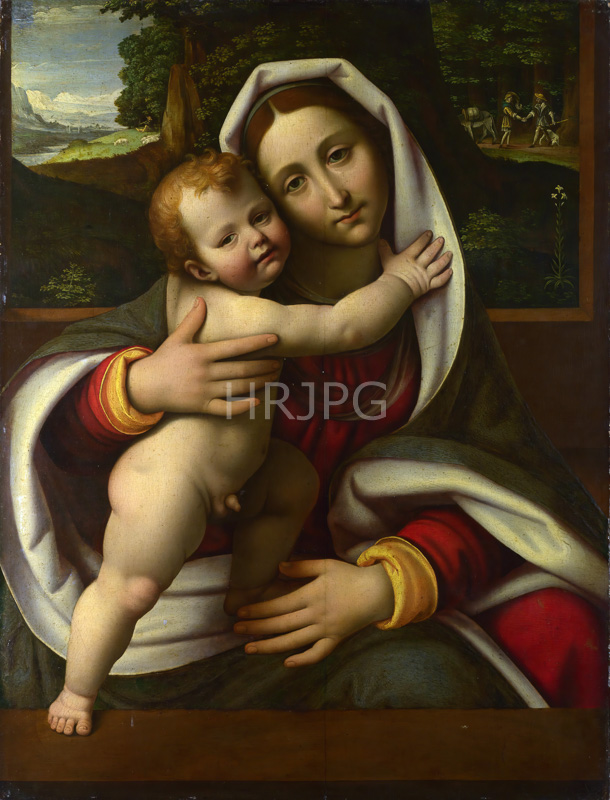
Andrea Solario’s "The Virgin and Child" is a masterpiece of technical refinement and psychological depth, showcasing the artist’s unique ability to blend the atmospheric innovations of Leonardo da Vinci with the crisp, detailed realism of the Northern European tradition. Painted during Solario’s residence in France or immediately after his return to Milan, it depicts the Virgin Mary embracing the infant Christ, who stands on a stone parapet. This architectural device, rooted in early Renaissance tradition, provides a bridge between the sacred space of the holy family and the viewer’s own world. The composition is further enhanced by a window in the background that reveals a vast, atmospheric landscape populated with tiny travelers—likely a reference to the Flight into Egypt.
The physical presence of the figures is modeled with a startling clarity and volume. Solario uses a focused light source that highlights the varying textures of the skin and the luxurious fabrics. The influence of Leonardo is visible in the idealized, serene expression of the Virgin and the subtle "sfumato" that blurs the boundaries between her forms and the surrounding air. However, Solario’s preference for brilliant, saturated colors—seen here in the Virgin’s traditional red gown and deep blue mantle—distinguishes him from the more muted palettes of other "Leonardeschi." The infant Christ is rendered with a muscular naturalism, his active pose and intense gaze toward his mother creating a sense of life and movement. The use of "chiaroscuro" creates deep, articulated shadows that define the sculptural folds of the drapery and the physical weight of the figures.
The background landscape is a marvel of aerial perspective and narrative detail. Using pale blues and misty greys, Solario creates a sense of profound space that recedes toward a distant, sunlit horizon. The inclusion of the travelers adds a layer of narrative richness to the devotional image, suggesting the challenges and divine protection that defined the life of the holy family. Technically, the smooth, enamel-like finish of the oil-on-panel reflects Solario’s mastery of his medium and his scientific curiosity about the "imitation of nature." As part of prestigious collections like the Louvre or the National Gallery, this work remains one of the most admired examples of the Lombard Renaissance, standing as a testament to Solario’s status as a master who could bridge different European aesthetic traditions to create a unique and enduring vision of sacred beauty.