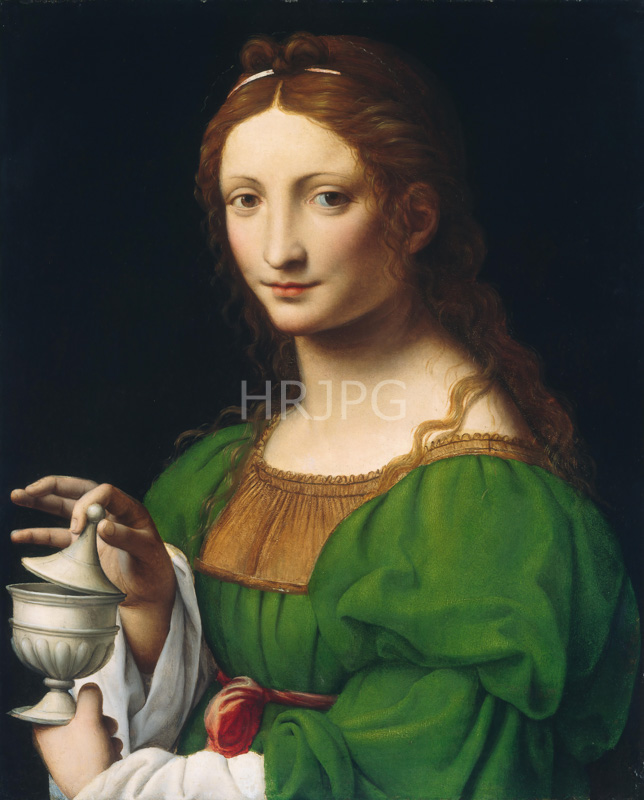
Bernardino Luini’s "The Magdalen" is an icon of High Renaissance grace and spiritual beauty, representing the peak of the Milanese school's idealization of female saints. Mary Magdalene is depicted in a half-length portrait, a format that emphasizes the psychological stillness and refined elegance of the subject. She holds her primary attribute, an ornate metallic ointment jar, and is dressed in a vibrant green gown that reflects her life of worldly luxury and her subsequent conversion. Luini, who was the most popular of Leonardo da Vinci’s followers, managed to translate the master’s revolutionary techniques into a visual language characterized by "dolcezza"—a pervasive sweetness and rhythmic harmony.
The figure of the Magdalene is modeled with an exceptional use of "sfumato," giving her skin a luminous, porcelain-like quality. Her face is an idealized vision of "Leonardesque" beauty—downcast eyes, a straight nose, and the subtle, enigmatic smile that became Luini’s signature. Her hair is meticulously braided and styled in the Milanese fashion, each strand catching the light with a soft, diffused glow. The use of "chiaroscuro" provides a powerful sense of three-dimensional volume, as if the saint were emerging from the dark, monochromatic background into the viewer’s immediate space. This dramatic lighting pushes the figure forward, making her physical presence and the tactile quality of the ointment jar the central focus of the viewer’s gaze. The influence of Leonardo’s anatomical studies is visible in the delicate rendering of her hands and the subtle tension in her pose.
During the Renaissance, the figure of the repentant Magdalene was a powerful symbol of redemption and divine love. Luini’s version, however, focuses on her spiritual and intellectual dignity rather than her suffering. The work was likely intended for the private chapel or study of a high-ranking Milanese patron who valued both the theological significance of the saint and the aesthetic perfection of the Vinci style. Technically, the painting is characterized by a high degree of finish and a harmonious color palette dominated by greens and warm flesh tones. While Luini was once seen as a mere imitator, modern scholars recognize his role in standardizing and disseminating the High Renaissance style to a wide audience across Italy. This "Magdalen" (found in the National Gallery or similar institutions) remains a hauntingly beautiful reminder of the enduring power of the Vinci ideal and its ability to imbue traditional iconography with a sense of eternal grace.