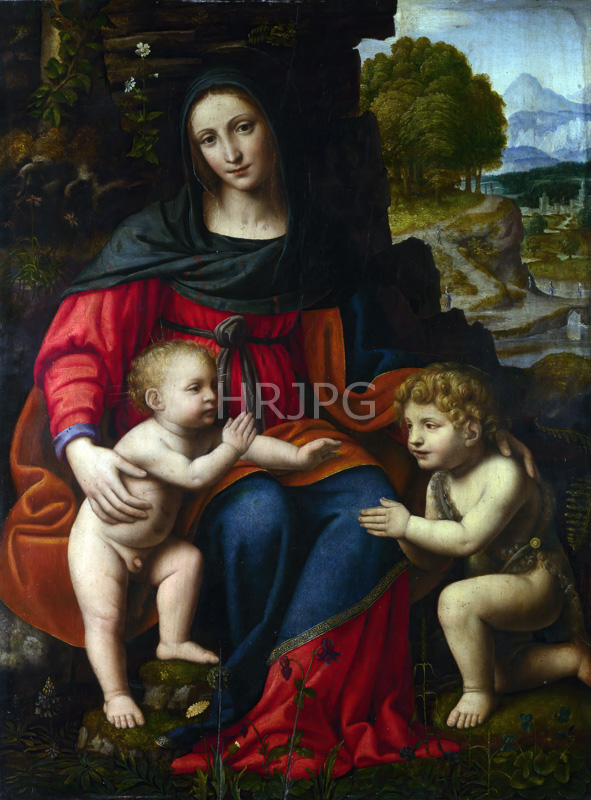
Bernardino Luini’s "The Virgin and Child with Saint John the Baptist" is a masterpiece of narrative harmony and maternal tenderness, reflecting the high cultural aspirations of early 16th-century Milan. This composition features the Virgin Mary cradling the infant Christ while a young Saint John the Baptist offers a basket of fruit, a symbolic gesture referring to the Fall of Man and Christ’s role as the new Adam who brings redemption. The figures are set against a dramatic backdrop of dark, jagged rocks that open to reveal a sunlit, winding landscape in the far distance. This contrast between the primordial interior and the vast, atmospheric world beyond is a direct homage to Leonardo da Vinci’s "Virgin of the Rocks."
The figure of the Virgin is modeled with the soft, diffused light and idealized features that became Luini’s signature. Her expression is one of serene, interior focus, her gaze directed toward the interactions of the two children. The infant Christ and Saint John are rendered with a remarkable naturalism, their chubby, realistic anatomy reflecting the scientific studies of human growth pioneered by Leonardo. Luini uses "sfumato" to create incredibly soft transitions of light and shadow, giving the skin a luminous, porcelain-like quality. The lighting appears to emerge from within the figures, highlighting the delicate textures of the hair and the complex folds of the Virgin’s traditional red and blue garments. This treatment of light creates a sense of warmth and spiritual intimacy that was Luini’s trademark.
The landscape in the background is a marvel of aerial perspective. Using pale blues and misty greys, Luini creates a sense of profound space that recedes toward a sunlit horizon, populated with tiny travelers and architectural ruins. This landscape is not merely decorative but suggests the cosmic scale of the sacred event taking place in the foreground. Technically, the painting showcases Luini’s mastery of the oil medium and his commitment to the "imitation of nature." The individual strands of the children’s hair and the varied textures of the fruit and the rocks are rendered with a precision that reflects the high standards of the Milanese school. Historically, this work served as a powerful object for private devotion and was part of the wider dissemination of the High Renaissance style. Luini’s ability to capture the "sweetness" and eternal grace of the Vinci legacy made him the most successful artist of his generation, and this work remains a hauntingly beautiful testament to his enduring artistic vision.