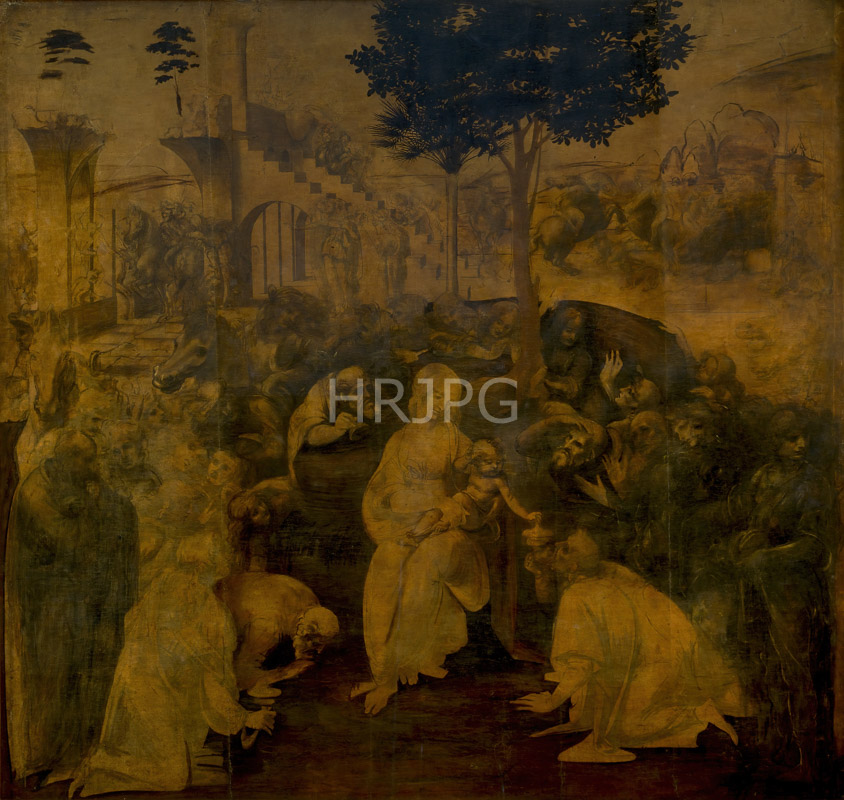
Leonardo da Vinci’s "Adoration of the Magi" is one of the most complex and revolutionary unfinished works in the history of Western art. Commissioned by the monks of San Donato a Scopeto in Florence, Leonardo worked on this massive panel until his departure for Milan in 1482, leaving it in an underpainted state of yellow ochre and bistre. Despite its "unfinished" status, the work provides an invaluable window into Leonardo’s creative process, showcasing his mastery of composition, movement, and psychological intensity. The central scene features the Virgin Mary and the infant Christ surrounded by a chaotic, swirling crowd of Magi and spectators. Unlike traditional depictions, which were often static and orderly, Leonardo introduces a sense of high drama and emotional turbulence, where each figure reacts to the divine revelation with a unique, individual gesture.
The composition is famously organized in a dynamic pyramidal structure, with the Virgin and Child forming the stable center of an otherwise chaotic vortex. In the background, Leonardo introduces a series of surreal and ambitious elements: ruined classical architecture, a staircase that leads to nowhere, and a group of horsemen engaged in a violent skirmish. These elements have been interpreted as symbols of the decline of the pagan world and the birth of a new, Christian era. The background also showcases Leonardo’s early experiments with deep linear perspective and the "Vinci-style" jagged mountains that recede into a hazy, atmospheric distance. The individual figures—many of them possessing the "grotesque" or highly characterized features that Leonardo loved—demonstrate his profound study of human physiognomy and the "motions of the mind."
Technically, the "Adoration" is a masterpiece of light and shadow, even in its monochromatic state. Leonardo uses a sophisticated "chiaroscuro" to anchor the figures and create a sense of three-dimensional space. The way the light appears to filter through the crowd to illuminate the Christ Child reflects his belief that light is the primary vehicle for divine grace. The painting represents a radical departure from the 15th-century Florentine tradition, paving the way for the monumental achievements of the High Renaissance. As a centerpiece of the Uffizi Gallery, it remains a subject of intense study and restoration, continuing to fascinate scholars with its hidden layers and its ambitious, almost modern sense of complexity and movement. It stands as a testament to the early genius of the world's most celebrated polymath.