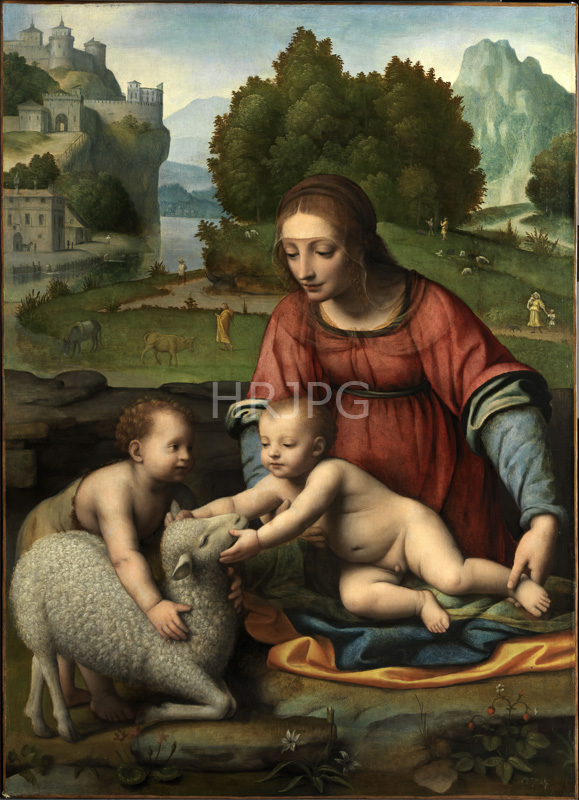
Bernardino Luini’s "The Virgin and Child with Saint John and a Lamb" is a quintessential masterpiece of the "sweet" style that made him the most popular popularizer of Leonardo da Vinci’s innovations in Lombardy. Created during his full maturity, this work captures a moment of profound maternal tenderness and divine prophecy. The Virgin Mary is shown watching over the infant Christ, who is playfully embracing a lamb—a poignant symbol of his future sacrifice as the "Lamb of God." Beside them, a young Saint John the Baptist looks on with a serene, knowing expression, his presence providing a bridge between the Old and New Testaments. The interaction between the figures is characterized by a rhythmic harmony and a quiet, domestic peace that was Luini’s trademark.
The figure of the Virgin is modeled with Luini’s characteristic softness, her face an idealized vision of "Leonardesque" beauty—heavy-lidded eyes, a straight, noble nose, and a subtle, enigmatic smile. The use of "sfumato" is masterfully applied to the transitions of light and shadow, giving the skin a luminous, porcelain-like quality. The infant Christ is rendered with a remarkable naturalism, his chubby, realistic anatomy and focused gaze toward the lamb reflecting the scientific studies of human growth pioneered by Leonardo. The lighting is soft and diffused, appearing to emerge as if from a divine source to highlight the delicate textures of the hair and the complex folds of the Virgin’s traditional red and blue garments. This treatment of light creates a sense of warmth and spiritual intimacy that avoids the intellectual coldness often found in other Leonardo followers.
The landscape in the background is a marvel of Renaissance atmospheric perspective. Using pale blues and misty greys, Luini creates a sense of vast, unbridgeable space that recedes toward a sunlit horizon, populated with the typical "Leonardesque" jagged mountains and winding paths. This landscape is not merely decorative but suggests the cosmic scale of the sacred event taking place in the foreground. Technically, the painting showcases Luini’s mastery of the oil medium and his commitment to the "imitation of nature." Historically, such images were highly popular for private devotion, providing the viewer with a beautiful and emotionally resonant object for meditation. Luini’s ability to capture the "sweetness" and eternal grace of the High Renaissance spirit made him the primary guardian of the master's legacy in Milan, and this work remains a hauntingly beautiful testament to his enduring artistic vision.