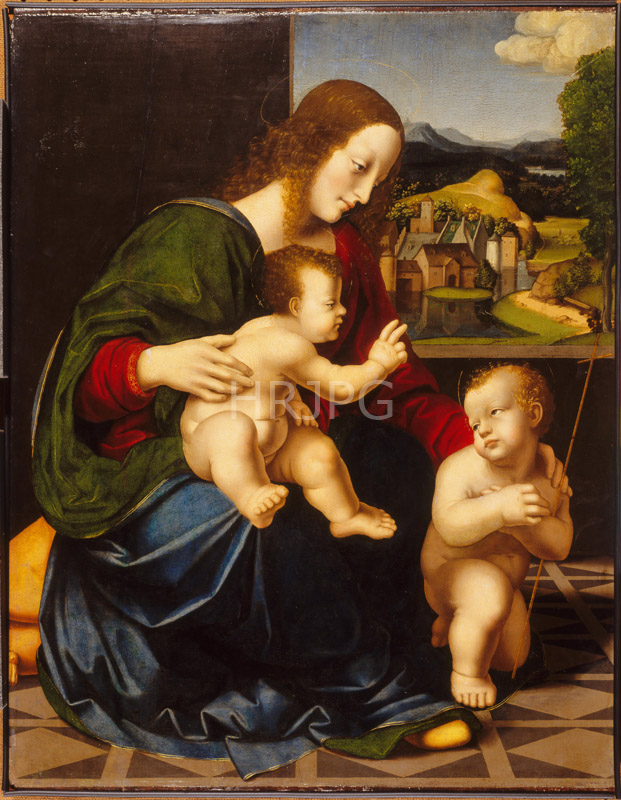
Marco d'Oggiono was one of the most prolific and faithful members of Leonardo da Vinci’s Milanese circle, and this "Madonna and Child with Saint John the Baptist" is a perfect example of his ability to replicate the master’s style while adding a distinct sense of solidity and decorative flair. Marco is perhaps best known for his large-scale copy of the "Last Supper," and his understanding of Leonardo’s compositional and technical principles is evident here. The Virgin Mary sits with the infant Christ, who interacts with a young Saint John the Baptist in a lush, wooded landscape. The composition is characterized by a stable, pyramidal structure and a focus on the psychological connection between the two children, who are rendered with a soft, idealized beauty.
The modeling of the figures is achieved through a sophisticated use of "sfumato" and "chiaroscuro." Marco employs soft transitions between light and shadow to create the rounded volume of the Virgin’s face and the chubby, realistic anatomy of the infants. The Virgin’s expression is one of serene, maternal devotion, with her downcast eyes and subtle smile echoing the enigmatic countenances of Leonardo’s own work. The background landscape is a marvel of Renaissance observation, featuring architectural ruins and jagged blue mountains that recede into a hazy, atmospheric distance. This use of "aerial perspective" creates a sense of deep, habitable space that provides a monumental context for the sacred scene. The botanical details in the foreground, such as the carefully rendered leaves and grasses, reflect the workshop's obsession with the scientific study of nature.
Technically, the painting showcases Marco’s mastery of the oil-on-panel medium. The rich color palette, dominated by the Virgin’s traditional red gown and deep blue mantle, is unified by a soft, golden light that filters through the canopy. The textures of the fabrics and the individual strands of the hair are rendered with a precision that reflects the high technical standards of the Milanese school. During the early 16th century, images of the "Madonna and Child" were central to both public altarpieces and private devotion, and Marco’s versions were highly sought after for their balance of physical realism and divine grace. While he lacked the radical intellectualism of Leonardo, Marco’s work played a vital role in standardizing and disseminating the High Renaissance style across Northern Italy. This work remains a hauntingly beautiful reminder of the power of the Vinci ideal and its ability to transform a traditional religious subject into a profound exploration of human personality and nature.