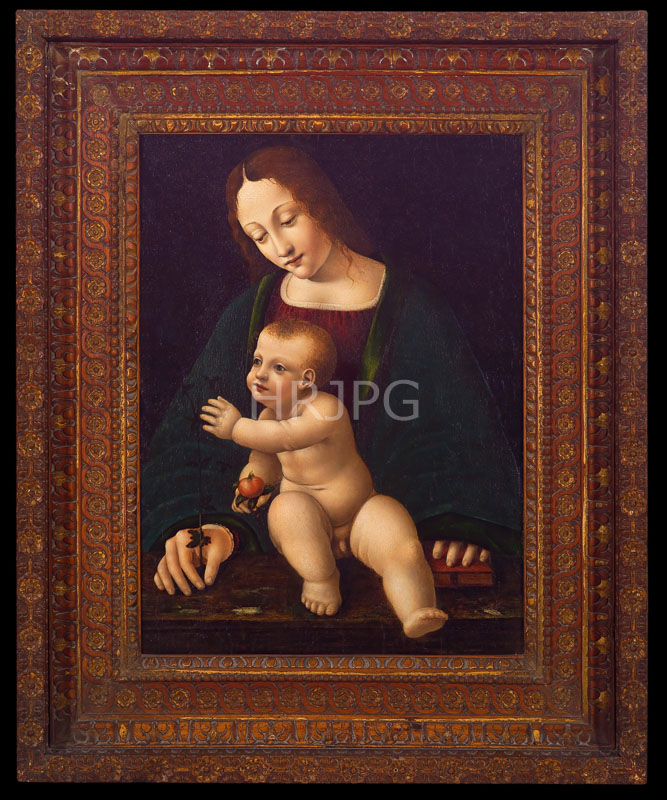
Bernardino de' Conti was a prominent Milanese portraitist and a talented follower of Leonardo da Vinci, and this "Madonna and Child" is one of his most representative religious works. Known for his rigorous and somewhat more stiffly linear style compared to the more atmospheric Luini, de' Conti nonetheless captured the high technical standards and the dignified presence that defined the Milanese school. In this panel, the Virgin Mary is shown gazing at the infant Christ, who sits on a stone parapet and holds a piece of fruit—a common symbol of the Fall of Man and the subsequent redemption brought by the savior. The composition is framed by two window openings in the background, a device that allows the artist to explore the "imitation of nature" through a meticulously detailed landscape.
The figure of the Virgin is modeled with a focused light that emphasizes the smoothness of her skin and the sculptural folds of her rich blue mantle and red gown. While de' Conti’s use of "sfumato" is less pervasive than in Leonardo’s own work, he achieves a powerful sense of three-dimensional volume through strong "chiaroscuro." The infant Christ is depicted with a precocious wisdom, his gaze directed toward the viewer or the symbolic fruit. The two window openings provide a visual bridge between the sacred, interior space and a serene, atmospheric landscape of blue mountains and winding paths. This use of aerial perspective reflects the High Renaissance interest in the vastness and divine order of the natural world, creating a sense of peace and monumental stability that was de' Conti’s trademark.
Technically, the painting is characterized by a high degree of finish and a clear, brilliant color palette. De' Conti’s mastery of the oil medium is evident in the tactile quality of the stone parapet and the individual strands of the Virgin’s hair. During the late 15th and early 16th centuries, the "Madonna and Child" motif was an essential part of the artistic repertoire, and de' Conti’s version reflects the intellectual and aesthetic climate of Milan under the Sforza family. His work is often noted for its "crystalline" clarity, which stands as a fascinating counterpoint to the more hazy, mysterious style of other "Leonardeschi." This painting (versions of which are held in the Pinacoteca di Brera or the Hermitage) remains a vital document of the Milanese Renaissance, standing as a testament to the diverse and highly successful regional styles that emerged from the master’s revolutionary legacy.