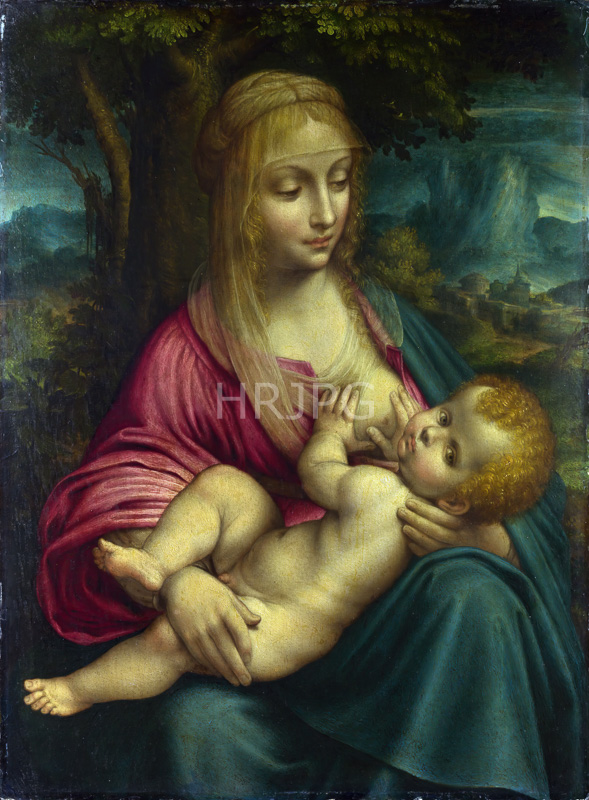
This "Virgin and Child," currently held in a prestigious private or public collection, is a beautiful and evocative example of the "Leonardeschi" style that dominated Milanese art at the turn of the 16th century. Though the specific hand of the artist remains a subject of debate—likely a talented anonymous pupil within the master's immediate circle—the work perfectly embodies the aesthetic and technical principles of Leonardo da Vinci. The Virgin Mary is depicted nursing the infant Christ (a "Madonna Lactans" motif) within an outdoor landscape. This specific iconographic tradition was highly popular in the Renaissance as it emphasized the humanity of Christ and the maternal tenderness of Mary, making the divine story more relatable to the viewer.
The modeling of the figure is achieved through a sophisticated use of "sfumato," particularly in the soft transitions across the Virgin’s forehead and around her eyes. This gives her skin a luminous, porcelain-like quality and a sense of three-dimensional volume. Her expression is one of quiet, almost melancholic contemplation, suggesting a complex inner life that remains inaccessible to the viewer—a hallmark of the "Vinci smile." The infant Christ is rendered with a remarkable naturalism, his chubby, realistic anatomy and active pose reflecting the scientific studies of human growth pioneered by Leonardo. The background is a dense grove of trees and jagged blue mountains that recede into a misty horizon, utilizing the principles of aerial perspective to create a sense of profound space and atmospheric depth.
Technically, the painting showcases the high standards of the Milanese school. The rendering of the varied textures—from the soft skin of the infants to the rough bark of the trees and the fine texture of the hair—demonstrates a commitment to the "imitation of nature." The lighting is soft and diffused, appearing to emerge as if from within the figures themselves, which unifies the composition and imbues it with a sacred, ethereal glow. This work reflects the intellectual and spiritual climate of Milan in the decades following Leonardo’s residency, where his radical innovations were standardized into a highly successful and recognizable regional style. It remains a hauntingly beautiful testament to the enduring power of the Vinci ideal and its ability to transform a traditional religious subject into a profound meditation on the human condition and the natural world.