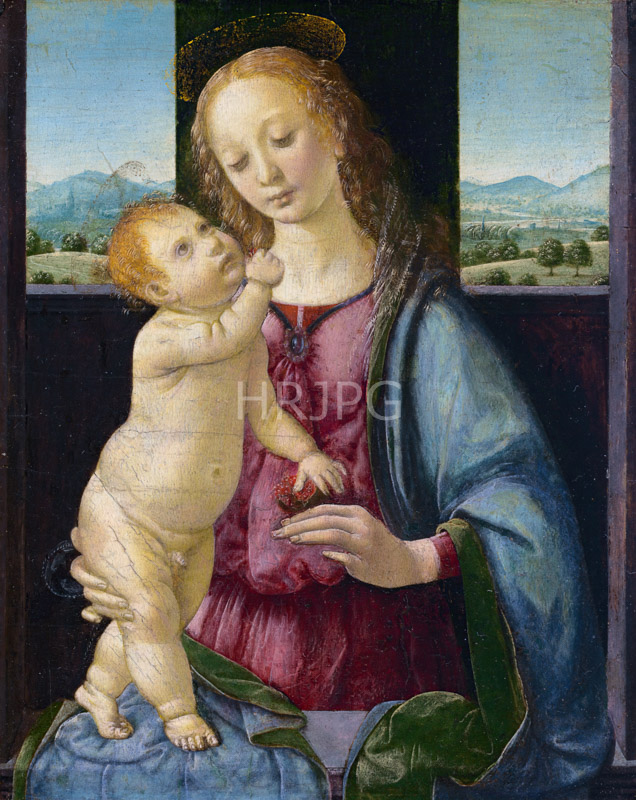
Lorenzo di Credi's "Madonna and Child with a Pomegranate" is a luminous and meticulously executed example of the Florentine High Renaissance style. Di Credi was a fellow pupil of Leonardo da Vinci in the workshop of Andrea del Verrocchio, and his work represents the more conservative, yet technically flawless, trajectory of that influential studio. In this composition, the Virgin Mary is depicted holding the infant Christ, who stands on a stone parapet. He clutches a pomegranate, a fruit whose numerous seeds and red juice symbolized both the fertility of the Church and the future Passion and sacrifice of Christ. The interaction between mother and son is characterized by a quiet, monumental calm and a sense of divine order that was central to Florentine religious art of the late 15th century.
The physical presence of the figures is modeled with a startling clarity and crispness. Unlike Leonardo’s hazy "sfumato," di Credi favored clear, distinct outlines and a smooth, enamel-like finish. The Virgin’s face is an idealized vision of maternal beauty—rounded features, heavy-lidded eyes, and a serene, focused expression. The infant Christ is rendered with a remarkable naturalism, his chubby anatomy and balanced pose reflecting the scientific rigor of Verrocchio’s training. The background features a meticulously detailed Tuscan landscape seen through two arched windows, a compositional device that provides a sense of profound space and air. This landscape, with its winding paths and delicate trees, is rendered with a precision that reflects the era's interest in the "imitation of nature."
Technically, the painting showcases di Credi’s mastery of the oil and tempera medium. The rich color palette, dominated by the Virgin’s traditional red gown and deep blue mantle, is achieved through numerous translucent layers that give the surface a brilliant, lasting luminosity. The lighting is steady and clear, highlighting the sculptural folds of the drapery and the porcelain-quality of the skin. This work was highly influential in Florence, serving as a model for devotional images that sought to balance physical realism with spiritual dignity. As a treasure of the National Gallery in Washington, D.C., it remains an essential piece for understanding the diverse artistic outcomes of the Verrocchio workshop and the evolution of the Virgin and Child motif in the lead-up to the High Renaissance.