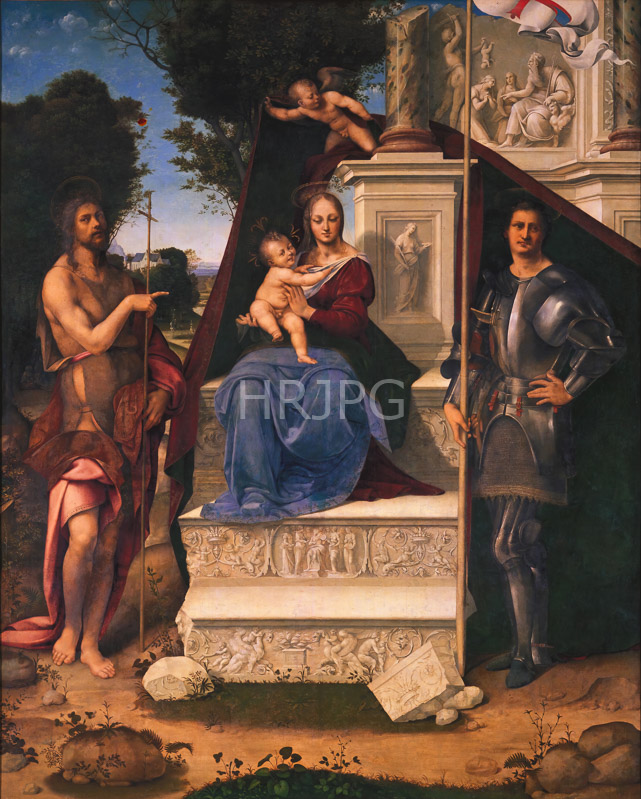
Cesare da Sesto’s "Madonna and Child with Saint John the Baptist and Saint George" is a magnificent example of the synthesis of Milanese and Roman styles during the High Renaissance. Cesare, who moved between Leonardo’s circle in Milan and the influence of Raphael in Rome, developed a unique aesthetic that combined Leonardesque "sfumato" with the monumental spatial organization and dynamic figures of Central Italian art. In this large-scale altarpiece, the Virgin and Child are seated on an elevated throne or classical ruin, flanked by the protective figure of Saint George and the prophetic Saint John the Baptist. Above them, a cherub arranges a cloth of honor, adding a sense of celestial drama to the sacred assembly.
The figure of the Virgin is modeled with a profound grace, her face reflecting the idealized beauty favored by Leonardo. However, the influence of Raphael is visible in the more complex, sculptural arrangement of the holy group and the rhythmic interaction between the characters. Saint George is depicted as a muscular, heroic knight, providing a powerful contrast to the serene Virgin and the ascetic Saint John. The background is a marvel of Renaissance observation, featuring classical ruins and a distant, atmospheric landscape that recedes into a hazy, blue horizon. This use of "aerial perspective" creates a sense of vast space that anchors the sacred figures within the cosmic order. The botanical details in the foreground are rendered with a scientific precision that reflects the Vinci workshop's obsession with nature.
Technically, the painting showcases Cesare’s fluid brushwork and his sophisticated use of color. The deep blues, vibrant reds, and metallic gleam of Saint George’s armor are unified by a soft, golden light that filters through the composition. The "sfumato" is applied masterfully to the transitions around the eyes and mouths of the figures, giving them a living, breathing presence. This work represents the peak of Cesare’s mature style, where he successfully merged the intellectual rigor of Milan with the theatrical and monumental innovations of Rome. As a cornerstone of the Museum of Fine Arts, San Francisco, or the National Gallery, this altarpiece remains one of the most important documents of the "Leonardeschi" evolution, illustrating how the master's foundational lessons were expanded into a more heroic and emotionally expressive visual language.