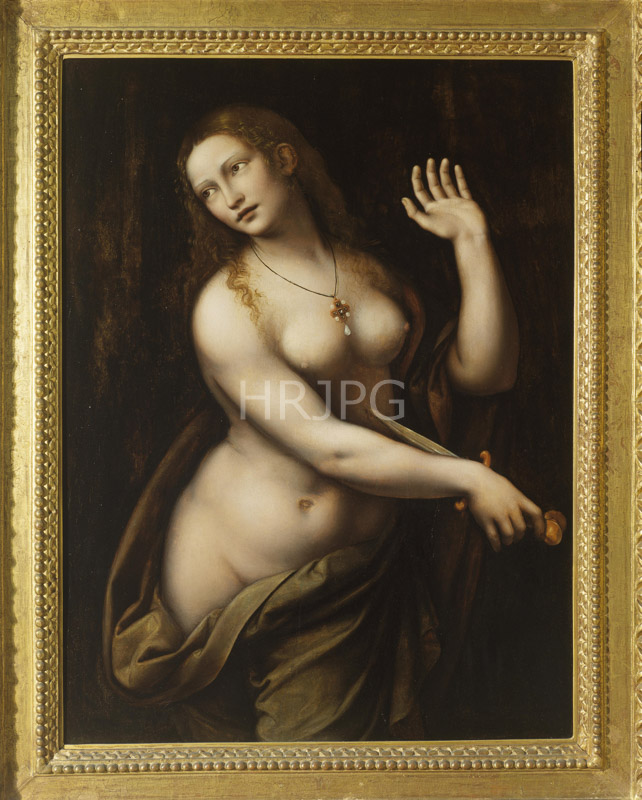
Giampietrino’s "Lucrezia Romana" is a powerful and unsettling exploration of one of the most famous tragedies of classical antiquity. The painting depicts the legendary Roman heroine Lucretia at the moment she decides to take her own life after being violated by the son of the king, an act that traditionally symbolized the transition of Rome from a monarchy to a republic. Giampietrino, following the aesthetic of his master Leonardo da Vinci, chooses to emphasize the "Leonardesque" grace and physical allure of the protagonist, creating a disturbing contrast between her idealized beauty and the violent sacrifice she is about to perform. She is shown in a half-length portrait, clutching a dagger to her bare breast, her gaze turned upward in a dramatic expression of tragic resolve.
The figure is modeled with an exceptional use of "sfumato," giving her skin a luminous, porcelain-like quality that seems to radiate from within the dark, shadowy background. Her facial features—the heavy-lidded eyes and the parted lips—suggest a state of intense psychological agony that is both human and divine. The use of "chiaroscuro" provides a powerful sense of three-dimensional volume, making her form appear to emerge from the darkness into the viewer’s space. This dramatic lighting pushes the figure forward, making her physical presence and the cold metallic sheen of the dagger the central focus of the viewer's gaze. The influence of Leonardo’s anatomical studies is visible in the delicate rendering of her hands and the subtle tension in her neck and shoulders.
During the 16th century, the story of Lucretia was a popular subject for its combination of moral virtue, political symbolism, and the opportunity to depict the idealized female nude. Giampietrino’s version is particularly notable for its "cold beauty" and its focus on the interior life of the character. The work was likely intended for the private collection of a sophisticated Milanese patron who valued both the classical narrative and the aesthetic perfection of the Vinci style. Technically, the smooth, enamel-like finish of the oil-on-panel reflects Giampietrino’s mastery of his medium and his ability to imbue even the most violent subjects with a sense of eternal, crystalline grace. It remains a hauntingly beautiful reminder of the power of art to confront the darkest aspects of the human condition through a visual language of peak elegance.