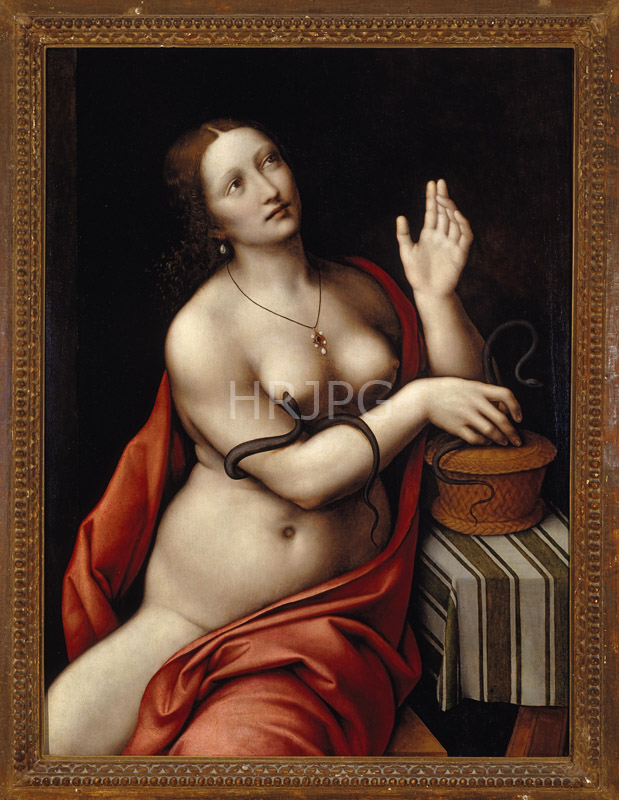
Giampietrino’s "The Death of Cleopatra" (the earlier version) is a superlative example of the Milanese school's fascination with tragic heroines and the "Leonardesque" ideal of feminine beauty. This painting depicts the final moments of the Egyptian queen, who according to legend chose to die by the bite of an asp rather than submit to Roman capture. Giampietrino presents Cleopatra as a figure of haunting physical allure, her nude torso modeled with the soft, diffused light and atmospheric "sfumato" pioneered by Leonardo da Vinci. The asp is shown coiled around her arm, its dark form providing a stark, symbolic contrast to the luminous, porcelain-like quality of her skin. Her gaze is turned toward the heavens, suggesting a state of psychological ecstasy and tragic resignation.
The technical execution of the flesh is a masterclass in the "Leonardeschi" style. Giampietrino employs ultra-thin layers of oil glazes to achieve incredibly soft transitions between light and shadow, giving the skin a translucent, lifelike quality. The outlines of her body are softly blurred, making her appear to emerge naturally from the deep, dark background. This use of "chiaroscuro" creates a powerful three-dimensional volume, emphasizing the sculptural grace of her form. Her expression—with its heavy-lidded eyes and subtle, enigmatic smile—echoes the mysterious countenances found in Leonardo’s own work, transforming a scene of death into a meditation on eternal beauty and divine focus.
During the Renaissance, the story of Cleopatra was a favorite subject for its combination of historical drama, erotic undertone, and the exploration of extreme emotional states. Giampietrino’s version prioritizes an overall sense of rhythmic harmony and aesthetic perfection over the grit of the historical event. The work was likely intended for a private study or "studiolo" of a noble patron who valued the intellectual and spiritual depth of the Vinci circle. Technically, the smooth, polished surface of the painting demonstrates Giampietrino’s mastery of the medium and his role as a primary guardian of the master's legacy. This "Cleopatra" remains a hauntingly beautiful icon of the High Renaissance, where the boundaries between the human and the divine are blurred through a visual language of peak elegance and technical refinement.