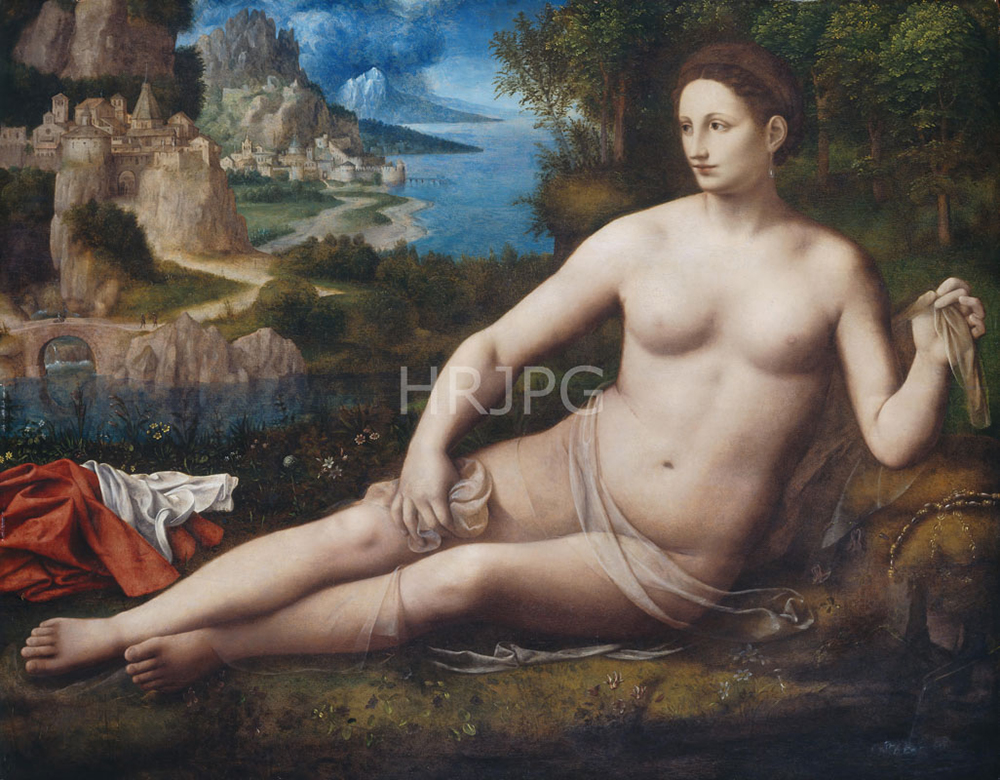
Bernardino Luini’s "Venus" is a masterpiece of his late period, representing a rare and poetic exploration of mythological beauty by the most popular of the "Leonardeschi." Luini, who was primarily known for his religious frescoes and devotional images, manages here to translate the sacred grace of his Madonnas into the secular realm of the classical goddess. Venus is depicted as a reclining nude in a lush, pastoral landscape, her form modeled with a soft, diffused light and atmospheric "sfumato" that directly echoes the work of Leonardo da Vinci. The landscape, featuring a bridge, architectural ruins, and distant blue mountains, provides a dreamlike and harmonious context for the idealized feminine form.
The figure of Venus is the epitome of Luini’s "sweet" style—rounded forms, heavy-lidded eyes, and a subtle, serene expression that suggests a state of eternal peace. Her skin is rendered with ultra-thin layers of oil glazes, giving it a luminous, porcelain-like quality that seems to catch the golden light of late afternoon. Unlike the more eroticized Venuses of the Venetian school, Luini’s goddess possesses a quiet, almost virginal dignity that aligns her with the spiritual purity of his religious works. The use of "chiaroscuro" is exceptionally soft, creating a powerful sense of volume without harsh outlines, making her appear as a natural extension of the landscape itself.
The background is a marvel of Renaissance atmospheric perspective, where the blue-tinted mountains fade into a pale, luminous horizon. The inclusion of the bridge and the ruins reflects the High Renaissance fascination with the classical past and the transience of human achievement. Technically, the painting showcases Luini’s mastery of the oil medium and his commitment to the "imitation of nature." During the 1530s, this image of Venus would have been a prized object for a private collection, serving as both a celebration of physical beauty and a subject for intellectual contemplation. This work stands as a testament to Luini’s status as a bridge between the intellectual rigor of Leonardo and the more emotionally accessible beauty of the later Renaissance. It remains one of the most hauntingly beautiful and refined mythological images of the Milanese school.