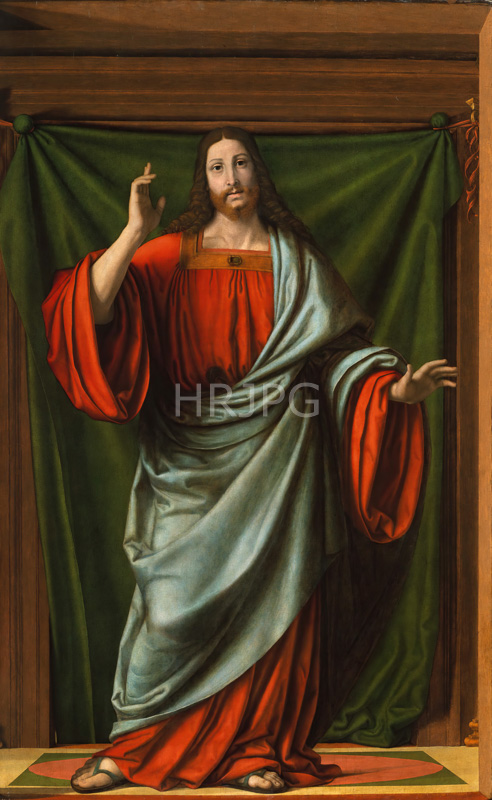
Andrea Solario’s "The Blessing Christ" is a profound and technically brilliant expression of High Renaissance spiritual dignity. Painted in the final year of the artist’s life, this work represents the culmination of Solario’s unique synthesis of Milanese "sfumato" and Northern European precision. Christ is shown in a formal, frontal half-length portrait, his right hand raised in a gesture of benediction and his left hand touching his chest. He is set against a rich, deep-green curtain that provides a stable and majestic backdrop, focusing the viewer’s attention entirely on the sacred presence. The composition is characterized by a monumental stillness and a deep psychological interiority that invites contemplative prayer.
The physical presence of Christ is modeled with a startling clarity and volume. Solario uses a focused light source that highlights the individual features of the face—the intense, compassionate gaze, the noble arch of the nose, and the soft, flowing curls of the hair. This focus on realistic detail, likely influenced by Solario’s exposure to Flemish and German masters like Dürer and Memling, creates a sense of living presence that was revolutionary. However, the influence of Leonardo da Vinci remains apparent in the soft transitions around the eyes and mouth, as well as the idealized beauty of the savior. The skin has a luminous, translucent quality, and the individual strands of hair are rendered with a scientific precision that reflects the high technical standards of the Milanese school.
Technically, the painting is a tour de force of oil glazing on panel. The vibrant colors—seen in Christ’s traditional red and blue garments—are unified by a soft, golden light that imbues the scene with a sacred glow. This work reflects the shifting needs of private devotion in the early 16th century, where patrons sought images that were both religiously profound and aesthetically "modern." Solario’s "Blessing Christ" became a highly influential archetype, demonstrating how the radical innovations of the High Renaissance could be adapted for traditional Catholic liturgy. As a centerpiece of the Metropolitan Museum of Art or the National Gallery, it remains one of the most admired examples of Solario’s mature period, standing as a testament to his status as a master who could bridge different European aesthetic traditions to create a unique and enduring vision of divine grace.