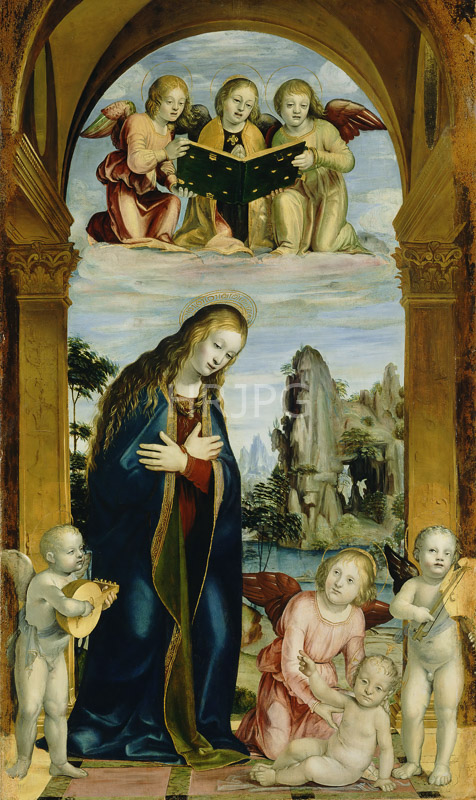
Bernardino Zenale’s "Madonna Adoring the Child with Musical Angels" is a masterpiece of the early Lombard Renaissance, showcasing the artist’s mastery of complex architectural perspective and the interaction of diverse characters. Zenale, who was a close associate of Bramante and influenced by Leonardo da Vinci, developed a style characterized by structural rigor and a deep sense of rhythmic harmony. In this composition, the Virgin Mary kneels in prayer before the infant Christ, who is supported by a group of youthful, curly-haired angels playing lutes and singing. The scene is set within an ornate classical arch that provides a sense of monumental dignity and opens to reveal a rugged, "Vinci-style" landscape of jagged rocks and distant blue mountains.
The figure of the Virgin is modeled with a soft, diffused light that highlights her serene, focused expression. Her posture is stable and dignified, anchored by the heavy, rhythmic folds of her rich blue mantle. The musical angels are rendered with a soft, androgynous beauty, their poses and expressions conveying a sense of celestial joy and "Musica Sacra." Zenale’s use of "chiaroscuro" creates a powerful three-dimensional effect, emphasizing the physical volume of the architecture and the figures. The interaction between the human and the divine is handled with a profound sense of decorum and spiritual intensity. The infant Christ is depicted with a precocious wisdom, his small form radiating a light that appears to illuminate the surrounding figures.
Technically, the painting showcases Zenale’s mastery of the oil medium and his background in architectural theory. The individual jewels on the Virgin’s dress and the intricate patterns of the musical instruments are rendered with a precision that reflects the high cultural sophistication of the Milanese court under the Sforza family. The background landscape, with its pale blues and misty paths, utilizes aerial perspective to create a sense of profound space. During the late 15th century, such images were intended to document the intellectual and spiritual aspirations of the elite. Zenale’s "Adoration" (versions of which are held in the Getty Museum or the Pinacoteca di Brera) remains a vital document of the Milanese Renaissance, standing as a testament to the artist’s role in bridging the gap between the 15th-century tradition and the revolutionary innovations of the High Renaissance.