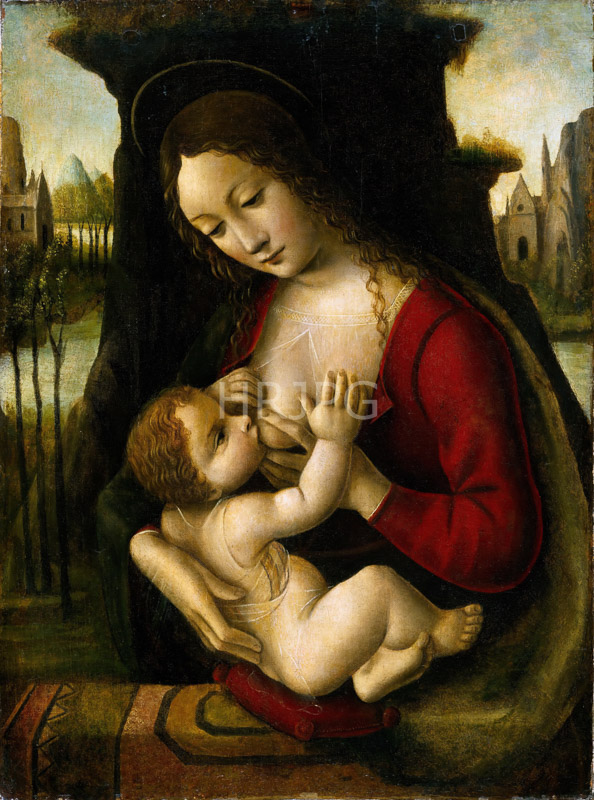
This "Virgin and Child" is a hauntingly beautiful and evocative example of the "Leonardeschi" style, clearly inspired by the master’s revolutionary compositions like the "Virgin of the Rocks." Attributed to a talented anonymous follower within the immediate Milanese circle, the work depicts the Virgin Mary nursing the infant Christ (the "Madonna Lactans" motif) within a dark, mysterious grotto. This setting, characterized by jagged rock formations and a misty, atmospheric opening to a distant landscape, is a direct homage to Leonardo’s exploration of primeval nature as a sacred space. The composition is characterized by a profound sense of stillness and maternal tenderness, where the divine mystery is presented through an intimate human interaction.
The modeling of the figure is achieved through a sophisticated use of "sfumato," particularly in the soft transitions across the Virgin’s face and her delicate hands. This gives her skin a luminous, porcelain-like quality and a sense of three-dimensional volume. Her expression is one of quiet, almost melancholic contemplation, suggesting a complex inner life that remains inaccessible to the viewer—a hallmark of the "Vinci smile." The infant Christ is rendered with a remarkable naturalism, his chubby anatomy and active pose reflecting the scientific studies of human growth pioneered by Leonardo. The dark interior of the grotto serves as a dramatic "chiaroscuro" device, projecting the figures forward and focusing the viewer's attention on the physical and spiritual weight of the scene.
Technically, the painting showcases the high standards maintained in the Vinci workshop. The rendering of the varied textures—from the soft skin of the infants to the cold, craggy surface of the rocks and the fine texture of the hair—demonstrates a commitment to the "imitation of nature." The lighting is soft and diffused, appearing to emerge as if from within the figures themselves, which unifies the composition and imbues it with a sacred, ethereal glow. This work reflects the intellectual and spiritual climate of Milan in the decades following Leonardo’s residency, where his radical innovations were standardized into a highly successful and recognizable regional style. It remains a hauntingly beautiful testament to the enduring power of the Vinci ideal and its ability to transform a traditional religious subject into a profound meditation on the origins of life and the nature of faith.