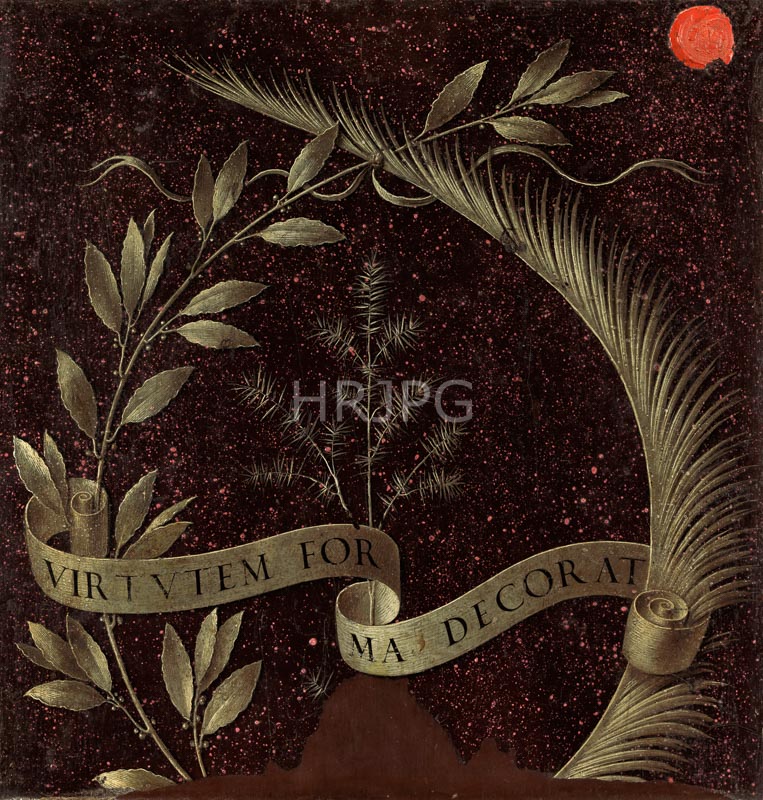
The reverse side of Leonardo da Vinci’s "Ginevra de' Benci" is as artistically and intellectually significant as the portrait itself, providing a rare window into the symbolic and heraldic world of the early Florentine Renaissance. It features a central sprig of juniper (known as "ginepro" in Italian), which serves as a clever visual pun on the sitter's name, Ginevra. The juniper is encircled by a wreath consisting of a branch of laurel and a palm frond, tied together by a ribbon bearing the Latin motto "Virtutem Forma Decorat" (Beauty Adorns Virtue). This heraldic device symbolizes the synthesis of intellectual virtue (laurel), moral victory (palm), and the individual’s character, asserting that Ginevra’s physical beauty is but a reflection of her inner moral worth.
The technical execution of the reverse side mirrors the extraordinary refinement of the portrait. Leonardo uses oil on the wood panel to achieve a sense of three-dimensional volume for the foliage and the ribbon. The individual leaves of the juniper and the laurel are rendered with a scientific precision that reflects the master's lifelong obsession with botanical studies. The lighting appears focused, casting subtle shadows that give the wreath a sculptural weight. The background is a simplified, atmospheric landscape that recedes into a hazy, pale sky, utilizing early forms of aerial perspective. This attention to the back of the painting was unusual for the time and suggests that the work was intended to be seen from both sides, perhaps displayed on a stand or as part of a luxurious, portable commission.
Scholars believe this emblem was likely commissioned by Bernardo Bembo, a Venetian diplomat and intellectual who maintained a high-profile platonic relationship with Ginevra. The motto highlights the neo-Platonic ideals of the Medici circle, where the "beautiful" was inextricably linked to the "good." The work has survived in remarkably good condition, preserving the vibrant greens and the crispness of the lettering. As a centerpiece of the National Gallery of Art in Washington, D.C., the reverse side of "Ginevra de' Benci" remains a vital object of study for those seeking to understand the intersection of poetry, social status, and symbolic language in Leonardo’s early career. It stands as a testament to the master’s belief that every part of a commission—no matter how secondary—should be a site of peak artistic and intellectual achievement.