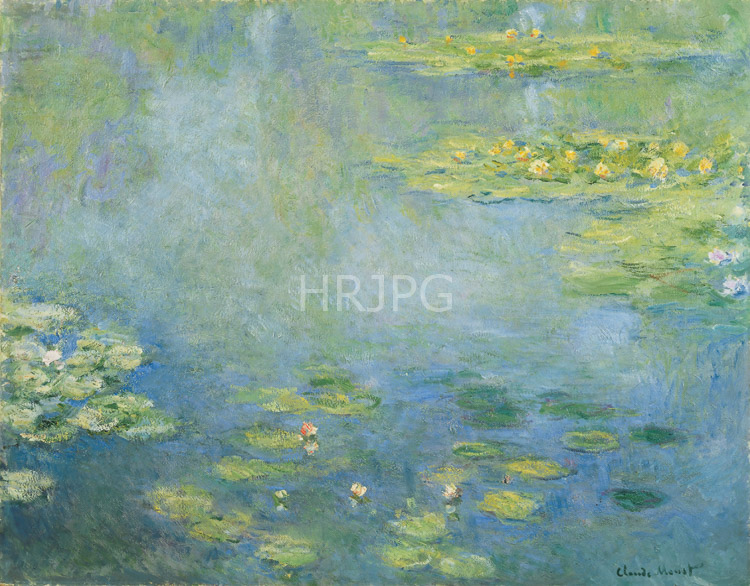
The visual logic of the painting is defined by the complete removal of the horizon line and any traditional spatial anchors. The viewer is suspended directly over the surface of the pond, which Monet renders as a liquid mirror for the overhead sky and the surrounding foliage. He utilizes a sophisticated and vibrant palette of deep emeralds, cerulean blues, and brilliant lemon yellows to represent the water's surface. The water lilies are treated as rhythmic, floating islands of color, their blossoms of soft rose and pale white providing a structural framework within the shimmering sea of reflections. The vertical reflections of the weeping willows create a complex pattern of depth that vibrates across the horizontal plane of the lily pads, creating a sense of immense, infinite space within a shallow, confined environment. This 'all-over' composition invites the eye to wander without a central focal point, suggesting a state of eternal flux and quiet, spiritual meditation.
Technically, the 1906 Water Lilies showcases Monet’s mastery of 'broken color' and gestural application. He applied the paint in short, rhythmic dabs and more fluid, horizontal strokes, building up a textured surface that has a physical presence and a tactile quality mirroring the organic life of the garden. He avoids the use of black entirely, opting instead for saturated purples and deep indigos in the shadows to maintain the painting's overall luminosity despite the complex layering of pigment. This chromatic approach ensures that every inch of the canvas vibrates with light, capturing the sensory 'impression' of the pond—the warmth of the afternoon sun and the coolness of the deep water—with an honesty that prefigures the modern abstract movements of the mid-20th century. The light is the primary actor, transforming the water into a shimmering field of color that makes the atmosphere feel as tangible as the lilies themselves.
Historically, the works produced between 1903 and 1908 were a massive success when exhibited at the Durand-Ruel gallery in 1909, hailed by critics as a triumph of modern vision. They represented a radical break from the 19th-century landscape tradition, turning the act of seeing into the ultimate subject of art. Today, held in major collections such as the Art Institute of Chicago and the Musée d'Orsay, the 1906 version is admired for its formal radicalism and its profound lyrical beauty. It remains a moving testament to Monet’s unrelenting creative spirit and his ability to find a universal, almost spiritual beauty in the simple rhythms of his own garden. It serves as a vital bridge between the Realism of his youth and the visionary abstraction of his final years, reminding us that for Monet, the beauty of the world was always found in the vibration of the light."